

Key Takeaway: Business travelers and leisure guests have fundamentally different booking windows, price tolerances, and stay patterns, and any hotel that prices them identically is leaving money on the table with both segments simultaneously.
Two Guests, One Price, Two Missed Opportunities
It is Tuesday evening. A sales executive from Bengaluru is searching for a hotel room in Pune for Wednesday night. His company has a ₹6,000 per night travel policy cap. He books within the cap, rarely negotiates, and will not cancel because his meeting is confirmed. He is not shopping around for the best deal. He wants a clean room, reliable Wi-Fi, and a 6 AM breakfast. He will book tonight.
Four days later, a couple from Mumbai is looking at the same hotel for Saturday night. They are celebrating an anniversary. They have no fixed budget, but they are comparing six properties across two booking sites. They will think about it for two days before committing. They are sensitive to perceived value. A free late checkout or a welcome amenity might be the deciding factor.
Both guests see the same room rate: ₹5,200.
The corporate traveler would have paid ₹5,800 without hesitation. The leisure couple almost booked a competitor offering a ₹4,999 anniversary package with complimentary dessert. The hotel captured neither guest at their maximum willingness to pay. It priced one rate and lost on both ends.
This is the core challenge of hotel weekend rates and corporate vs leisure pricing: two guest segments with different needs, different booking behaviours, and different price sensitivities arriving at the same property through the same channels, but rarely evaluated as separate revenue opportunities. Weekday occupancy and weekend ADR are problems with different roots that require different solutions. Treating them the same way is the single most common pricing error in independent hotel management.
Why a Single Rate Structure Fails Both Segments
Most independent hotels operate with a weekend rate and a weekday rate, possibly with seasonal adjustments. This two-tier structure is a reasonable starting point and a significant improvement over a single flat rate. But it still fails to account for the most important variable in pricing: the guest.
Corporate and leisure guests are fundamentally different buyers. Prostay's 2026 hotel booking data confirms this numerically: corporate guests average $180 per night while leisure guests average $145. The gap is not about product quality. It reflects different price sensitivity, different booking intent, and different relationships with cancellation risk. A corporate traveler is making a necessity booking with someone else's money within a policy framework. A leisure traveler is making a discretionary purchase with their own money, fully optional, with multiple alternatives.
The booking window gap is equally significant. Corporate bookings typically follow short lead times driven by meeting schedules, project demands, and last-minute travel approvals. Leisure bookings for weekends and holidays are planned further out, often two to four weeks in advance, with the guest actively monitoring prices across multiple channels before committing. These two booking windows overlap on your calendar but represent completely different demand curves. A rate that is appropriate for the corporate segment arriving on Wednesday with a three-day booking window is often too high to convert a leisure guest shopping on a Tuesday for the following Saturday.
The weekday occupancy problem is getting harder to solve with discounts alone. Lighthouse data from March 2026 confirms that one-night stay searches have risen 9% since 2023, with booking windows compressing simultaneously. Corporate travel has recovered to 85% of pre-pandemic levels globally, but that recovery is uneven: midweek city hotels benefit while leisure properties and mixed-segment independents face persistent Tuesday-Thursday gaps. Dropping rates publicly to fill those gaps trains price-sensitive guests to wait and undermines the rate integrity needed to hold corporate accounts at policy-compliant rates.
A hotel that solves only its weekend problem has solved half the revenue equation. A hotel that prices corporate guests and leisure guests as the same buyer has solved neither.
Four Strategies to Price Corporate and Leisure Segments Correctly
| Segment | Booking Window | Price Sensitivity | Key Desire |
|---|---|---|---|
| Corporate | Short (hours to 3 days) | Low — policy-bound | Reliable room, guaranteed availability |
| Leisure | Long (2-4 weeks ahead) | High — comparative shoppers | Perceived value, amenity additions |
-
Build a day-of-week pricing structure with segment logic, not just a flat weekend premium. A leisure destination property or resort should charge meaningfully higher rates on Friday and Saturday when leisure demand concentrates, and price Monday through Thursday at competitive levels to attract corporate and bleisure guests. A city or business-district property inverts this: weekday rates should be higher, reflecting corporate demand, while weekend rates may need to step down or be repositioned with leisure packages to maintain occupancy. Prostay 2026 data shows weekends typically generate 15-20% higher ADR than weekdays in most markets, but that premium must be calibrated by property type. Revenue data from 2026 shows the optimal weekend premium in urban markets now sits closer to 8-15%, not the 25-40% that older pricing playbooks assumed. Leisure guests in city hotels are more price-sensitive than they were three years ago. Compressing the weekend premium while lifting the weekday floor often produces better blended RevPAR than an aggressive Saturday spike followed by a deep Sunday-Monday discount.
-
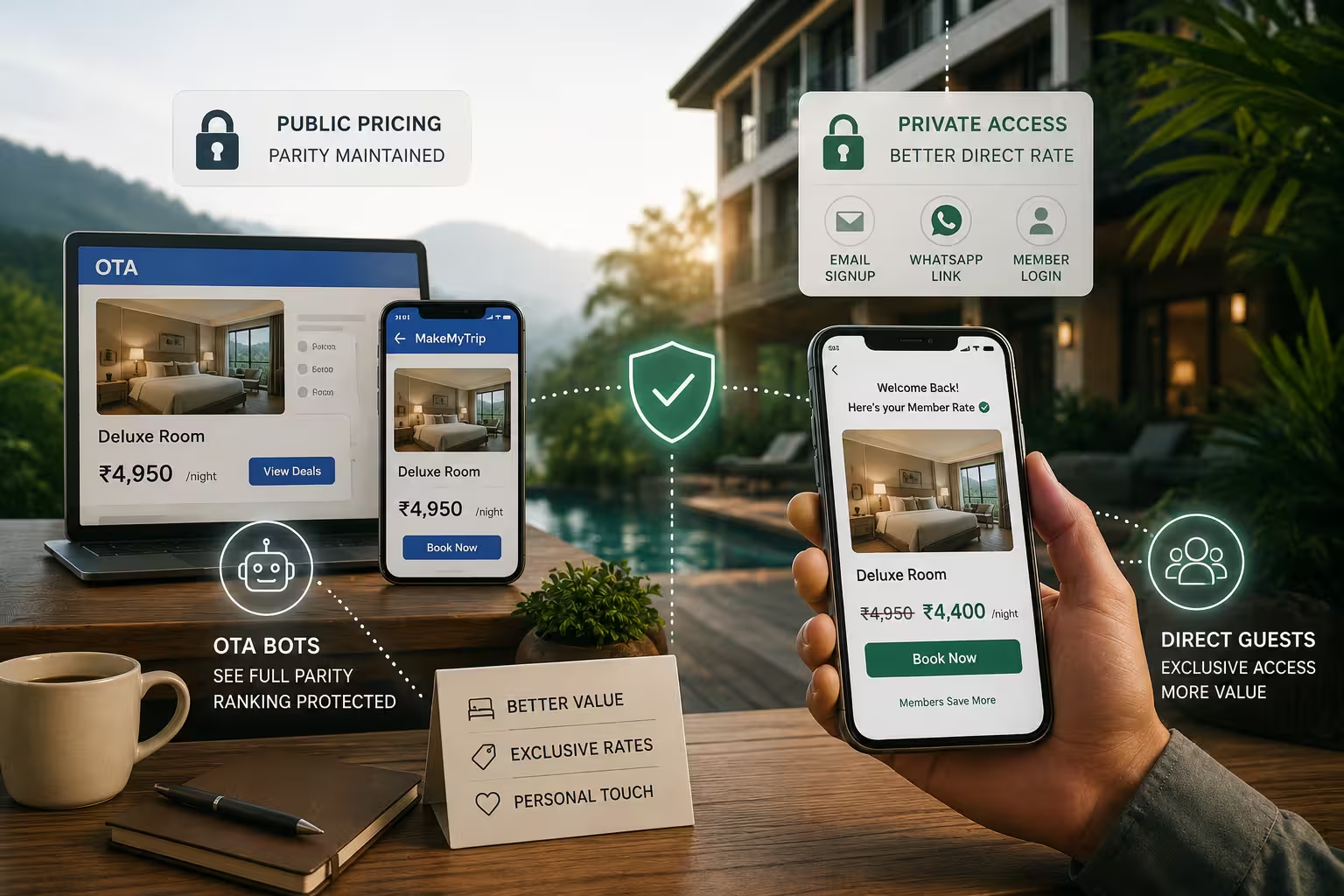
Create separate rate plans for each segment rather than relying on a single public BAR. Corporate guests should access their rate through a negotiated corporate code or a direct booking channel, not through the same public BAR that leisure guests see on OTAs. This separation achieves two things: it allows you to hold a higher weekday rate for corporate travelers while offering value-anchored leisure packages for weekend guests without one rate cannibalising the other. For the leisure segment, a weekend package that bundles the room with a late checkout, a welcome amenity, or an F&B credit at a rate positioned 8-12% above your standard BAR captures guests willing to pay for perceived value without requiring a raw rate increase. For the corporate segment, a negotiated rate with flexible cancellation and a guaranteed room category is more persuasive than any discount. Corporate guests prioritise reliability over price within their travel policy cap.
-
Use the bleisure trend to bridge weekday and weekend occupancy gaps. The global bleisure market is projected to exceed $731 billion by 2032, driven by business travelers extending trips for leisure. Marriott reports business trip lengths are already up 20% from 2019 levels. For independent hotels, this means the sharpest weekday occupancy opportunity is not in deeper discounting but in packaging. A midweek extended-stay offer, available only on your direct booking channel, that pairs a competitive Tuesday-Thursday rate with a discounted Friday-Saturday extension pulls the bleisure traveler through your weakest occupancy period and into your leisure peak. 28% of event attendees are likely to book extra nights for leisure (HotelTechReport, 2025), making every corporate conference or local business event a direct weekday-to-weekend bridge opportunity if your rate structure makes it easy to extend.
-
Protect your weekend ADR with value additions, not rate cuts. When weekend leisure occupancy softens, the instinct is to reduce the Saturday rate. This is almost always the wrong first move. A lower Saturday rate is visible to every price-comparing leisure guest and every future corporate traveler forming an impression of your market position. Before adjusting the rate, adjust the package. Add a late checkout, a complimentary activity, or a room upgrade offer at the existing rate. Leisure guests making a discretionary purchase are significantly more responsive to perceived value than to marginal rate differences. A ₹5,500 room with a 2 PM checkout and a rooftop sundowner converts better than a ₹4,999 room with nothing added, and it protects your ADR in every channel simultaneously.
A Real Split-Segment Strategy: One Hotel, Two Revenue Problems Solved
A 38-room property in Coimbatore sits in a mixed location: close enough to the industrial belt to attract corporate travelers on weekdays, and popular enough with families for weekend getaways from Chennai. For most of its history, it had operated on a single public rate with a modest weekend uplift. Weekday occupancy averaged 44%. Weekend occupancy averaged 81%. Blended RevPAR was acceptable but not growing.
The revenue manager spent one week redesigning the rate structure around segment logic rather than day-of-week alone.
| Step | Action | Outcome |
|---|---|---|
| Step one | Corporate rate (₹4,800) via direct booking + corporate code, Mon-Thu only, free cancellation, guaranteed room | Visible to corporate segment without OTA friction |
| Step two | Weekend BAR held at ₹5,200; "Weekend Retreat" package at ₹5,600 with late checkout + amenity + F&B credit, listed on direct + one OTA | 34% of Saturday bookings chose package, ₹400 more/night than BAR |
| Step three | "Stay Through the Weekend" email offer to past 90-day corporate guests: extend midweek booking through Sat at ₹4,500 | 3 bleisure extensions booked directly |
By week three: Corporate inquiries through the direct booking channel increased as the corporate rate was visible and bookable without OTA friction. Weekday occupancy moved from 44% to 61% over the following month.
By week six: Three bleisure extensions had been booked through the email offer. Average length of stay for corporate guests increased from 1.4 nights to 1.9 nights. Blended RevPAR for the 30-day period rose 18% against the prior comparable month, with the gain split nearly evenly between improved weekday occupancy and improved weekend ADR.
No rate was slashed. No broad promotion was run. Two guest types were priced as two separate problems, and both problems were solved.
The Bottom Line: Segment First, Price Second
Hotel weekend rates and weekday occupancy are not versions of the same problem. They are two distinct demand challenges that share a calendar but involve entirely different buyer behaviours, booking windows, and price tolerances.
The hotels that resolve both consistently are the ones that stop asking "what should our rate be this week?" and start asking "what does the corporate guest need, what does the leisure guest need, and how do we build a rate structure that serves both without one undermining the other?"
Corporate vs leisure pricing discipline is not about complexity. It is about clarity. Know which guest you are pricing for on which date, and build the rate, the package, and the channel to match that guest's decision-making process.
Take two actions this week to begin separating your segments:
-
Pull your last 60 days of booking data and split arrivals by day of week. Calculate your average rate and occupancy for Monday-Thursday separately from Friday-Sunday. If weekday occupancy is below 55% and weekend occupancy is above 75%, you have a segment gap that a dedicated corporate rate plan will address more effectively than any blanket weekday discount.
-
Create one weekend package on your direct booking engine this week. Take your existing Saturday BAR, add a late checkout and one low-cost amenity (welcome drink, room upgrade at check-in subject to availability, local snack), price the package 8-10% above BAR, and list it exclusively on your direct channel. Track how many weekend bookings shift to the package over the following 30 days. If more than 20% of Saturday guests choose it, you have confirmed that your leisure segment responds to value, not just rate, and you have a direct ADR improvement with no channel commission attached.
The segments are already there. The revenue is already available. The only thing missing is a rate structure that reaches both.
Ready to build a hotel weekend rates and corporate vs leisure pricing strategy tailored to your property? Grow Engine works with hotels across India and globally to implement revenue management systems that fit your market, your guests, and your goals. Get in touch with us today.