

Key Takeaway: Hotel rate parity is no longer a legal obligation in most markets, but any property that publicly exercises its freedom to undercut OTAs will be punished algorithmically, which means the only way to genuinely offer cheaper direct rates in 2026 is to hide them from the bots entirely.
The Property That Used Its Legal Freedom and Paid for It
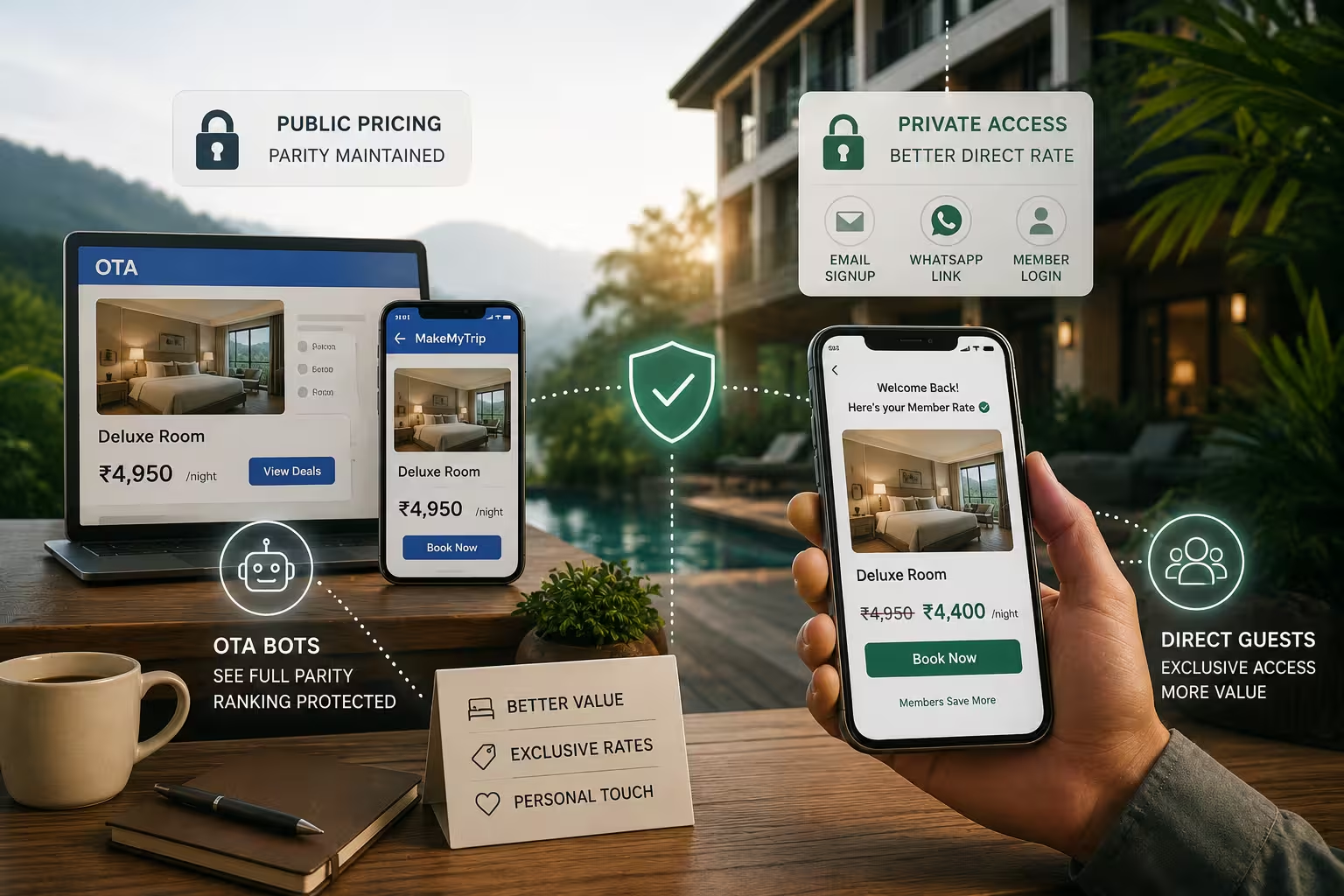
It's Monday morning in Kerala. A revenue manager has just read about the CCI's rulings against MakeMyTrip. Wide parity clauses are anti-competitive. The property can now offer a cheaper direct rate without contractual penalty. She lowers the direct booking engine rate by 12 percent. MakeMyTrip still shows ₹4,950. The website shows ₹4,400.
By Thursday, the property has slipped from third to eighteenth in MakeMyTrip's destination search results. A long weekend projecting 80 percent occupancy now looks like 52 percent. She reverses the rate on Friday morning.
Three kilometers away, a comparable property has done the same thing differently. The cheaper rate exists but sits behind a WhatsApp link and a member login page. OTA bots can't scrape it. The MakeMyTrip algorithm sees perfect parity on every public-facing page. The property's ranking holds and the direct bookings flow in at 15 percent below the OTA rate without the algorithm ever noticing.
This is the central reality of hotel rate parity in 2026. OTA parity rules are legally dead in most markets. But algorithmic enforcement never needed a contract. The question isn't whether ending rate parity is legal. It's whether you can do it without the OTA algorithm noticing.
Where Traditional Rate Parity Thinking Breaks Down
For fifteen years, the fight against rate parity was a legal battle. The EU's Digital Markets Act, fully enforced from late 2024, designated Booking.com as a gatekeeper and prohibited both wide and narrow parity clauses across the EEA. India's CCI penalised MakeMyTrip. France, Italy, and Germany banned parity clauses years earlier.
The legal framework now favors the hotelier in most markets. The problem is that OTAs never needed the contract. They have always had the algorithm.
When a property offers a publicly cheaper direct rate today, the OTA's ranking system reduces the "Price Competitiveness Score." No legal notice arrives. The property slides from page one to page four. Bookings drop. The revenue manager reinstates parity within days. The OTA never said a word.
This is where revenue managers make the wrong call: they conflate having a legal right with having an operational ability to exercise it. The two are completely separate in 2026.
There's also a deeper problem the industry hasn't fully processed. Agentic AI systems being deployed by Sabre, PayPal, and travel platforms in 2026 are beginning to replace human search for travel planning. These agents query structured data feeds and cross-reference pricing automatically. AI-driven search traffic converts at 14.2 percent, versus 2.8 percent for traditional browser search.
If an AI agent sees ₹4,400 on the direct API and ₹4,950 on Booking.com for the same room, it doesn't think "the direct rate is cheaper." It flags the data as inconsistent and removes the property from its recommendation set entirely.
The legal victory against rate parity arrived at exactly the moment fragmented pricing became an AI-discoverability problem. The industry fought fifteen years for a right that now costs bookings from the next generation of distribution if exercised publicly.
A Usable Framework: Cheaper Direct Rates Without Public Fragmentation
Closed User Group Rates (CUG): The Bot-Proof Discount
Problem: The property needs to offer cheaper direct rates to stimulate direct bookings without triggering OTA algorithmic penalties or creating fragmented pricing that AI agents flag as inconsistent data.
Why it works: A CUG rate sits behind an authentication wall: a login page, a WhatsApp link, or an email signup. OTA compliance bots can't scrape what they can't access without credentials. AI agents cross-referencing public data feeds never see the discount. The public-facing rate on both the OTA and the direct booking engine shows the same number, so the Competitiveness Score holds and structured data feeds remain consistent.
Real-world intuition: Think of a grocery loyalty card. The shelf price is the same for everyone. If you have the card, you pay less at the till. The OTA sees the shelf price. The direct guest sees the till price.
Implementation: Create an email capture page on the direct booking engine. Any guest who submits their email sees a rate 12 to 18 percent below the public BAR. Send the same link via WhatsApp to past guests. The OTA sees full parity. The direct guest books cheaper.
Gamified Discount Discovery: The JCPenney Lesson in Reverse
Problem: Displaying a permanently cheaper direct rate doesn't work behaviorally or algorithmically. But guests need a psychological reason to prefer direct.
Why it works: Consumers don't just want a lower price. They want to feel they've earned it. A rate requiring an action (entering a code, clicking a private link, replying on WhatsApp) creates the psychological sensation of winning. A permanent public discount creates the opposite: the guest anchors to the lower price as the real price and demands further reductions.
Real-world intuition: Airline loyalty programs print "members-only fare" in red. The fare may be marginally better. The sensation of exclusivity is what drives the booking.
Implementation: Replace "Book Direct" on the website with "Get the Member Rate." Gate it behind a 10-second email capture. The guest gets the lower rate. The property captures a direct marketing contact. The OTA bot sees no discrepancy.
Inventory Architecture: Fence the Premium, Feed the Base
Problem: Completely restricting OTA inventory is operationally impossible for most independent properties. But giving OTAs unrestricted access to all room categories means the most profitable room types are also the most heavily commissioned.
Why it works: OTAs generate demand most efficiently on price-elastic base inventory. Premium room categories attract aspirational, less price-sensitive guests who respond well to direct outreach and experience-led packaging.
Implementation: Restrict suites and premium rooms to direct channels only. Load only standard rooms into OTA allocations. The OTA drives volume on base rooms. The property captures 100 percent of the margin on its highest-yielding inventory without paying OTA commission on those bookings.
Value Bundling Instead of Public Rate Reductions
Problem: When demand softens, the reflex is to reduce the public rate. But public rate reductions trigger the ratchet effect: guests anchor to the lower price, and returning to the standard rate feels like a penalty. They cancel and rebook at lower rates using price-tracking tools.
Why it works: A bundle is a different product. A room plus late checkout plus a dining credit at ₹5,600 is not directly comparable to a room-only rate at ₹5,200. The guest perceives added value. The OTA algorithm sees the room component at a consistent rate. The AI data feed sees no pricing fragmentation. And the guest doesn't experience a reference price drop.
Implementation: Create one permanently available direct bundle: room plus one value addition with low variable cost (late checkout, early check-in, F&B credit, guided property experience). Price it 8 to 12 percent above the room-only BAR. Never drop the public room rate. If occupancy softens, enhance the bundle rather than cutting the room rate.
The Revenue Meeting Nobody Talks About: A Week in Munnar
A 36-room property in Munnar enters the week with an OTA dependency of 74 percent and a Diwali weekend still showing 61 percent occupancy with six days to arrival.
Monday: The revenue manager pulls 520 past guest contacts and sends a WhatsApp message: "Diwali at [Property]. Member rate active for 48 hours." The link behind it shows 16 percent below the OTA rate. No public channel is touched.
Tuesday: Fourteen reservations confirm. Occupancy reaches 74 percent. OTA search ranking unchanged. Direct booking rate: ₹6,100. The equivalent OTA booking, after 19 percent commission, would have netted ₹4,940.
Wednesday: A Diwali bundle activates on the direct engine: room plus complimentary thali dinner, priced ₹300 above room-only BAR. Three more direct bookings confirm.
Thursday: Occupancy hits 88 percent. OTA availability for Saturday closes. Remaining demand routes to the direct channel.
Friday close: 96 percent occupancy. Every WhatsApp and bundle booking carries zero OTA commission. Blended ADR materially higher than the prior Diwali period, when a public rate cut had been the primary demand tool. The OTA algorithm detected no parity issue throughout the week.
The Human Side: Why Smart Revenue Managers Still Volunteer Their Pricing Autonomy
Here's the uncomfortable truth behind the MakeMyTrip problem in India.
The CCI ruling is real. Independent properties are legally free to offer cheaper direct rates. But most Indian operators won't exercise that freedom. Not because they don't understand the ruling. Because the upfront "Money in the Bank" deposit the OTA offered at the season's start paid three months of staff wages.
When a dominant OTA provides a cash deposit in exchange for guaranteed inventory and baseline rate exclusivity, the independent owner doesn't experience that as a distribution deal. They experience it as working capital. Telling them to undercut the OTA isn't a revenue management recommendation. It's a request to antagonize their lender.
Loss aversion in Indian independent hospitality isn't about the fear of an empty room. It's about the fear of payroll default. No legal ruling changes that until properties build enough direct cash flow to reduce their OTA capital dependency.
What Independent Properties Should Do This Week
Build and gate a CUG rate this week. Set a rate 12 to 15 percent below your public BAR, accessible only through an email capture or WhatsApp link. Test it with a past-guest campaign before the next peak period.
Remove your premium room categories from OTA allocations. If suites or premium-view rooms are live on OTAs, pull them this week. Reserve those categories for direct channels only.
Audit public pricing consistency. Log into every active distribution channel and confirm the publicly visible rate is identical across all of them. AI agents are already flagging fragmented pricing.
Replace the next public rate cut with a direct bundle. When occupancy softens, add a low-cost value element to the direct rate and leave the OTA rate unchanged. Never drop the public anchor to stimulate short-term demand.
Start building your past guest WhatsApp list now. Every direct guest checkout should trigger a follow-up message with a member rate link. The CUG strategy only works at scale if the audience exists before the campaign is needed.
The Bottom Line: Stop Fighting Parity. Route Around It.
The paradox of 2026 is this: the legal right to end rate parity arrived at exactly the same moment that consistent pricing became essential for AI discoverability. Properties spent fifteen years fighting for a freedom that is now simultaneously legally granted and technologically dangerous to use publicly.
The answer is not to fight OTA parity on the public channels. The answer is to build distribution infrastructure that doesn't require the OTA to look.
A WhatsApp CRM. A member login page. A direct bundle that isn't a room rate. These aren't workarounds. They're the architecture of a direct booking strategy that works inside the algorithmic and AI constraints of the market as it actually exists in 2026, not as it existed when the legal battles were being fought.
Two things to do this week:
-
Create your first CUG rate on your direct booking engine today, gate it behind an email capture, and send the link to every past guest in your database. Measure how many bookings it generates in 14 days.
-
Remove your most premium room category from OTA allocations this week. Test for 30 days. Compare the revenue on those rooms to the equivalent period in the prior year when they were OTA-accessible.
Ready to build a direct booking and hotel rate parity strategy tailored to your property? Grow Engine works with independent properties across India and globally to implement revenue management systems that fit your market, your guests, and your goals. Get in touch today through https://www.growengine.in.