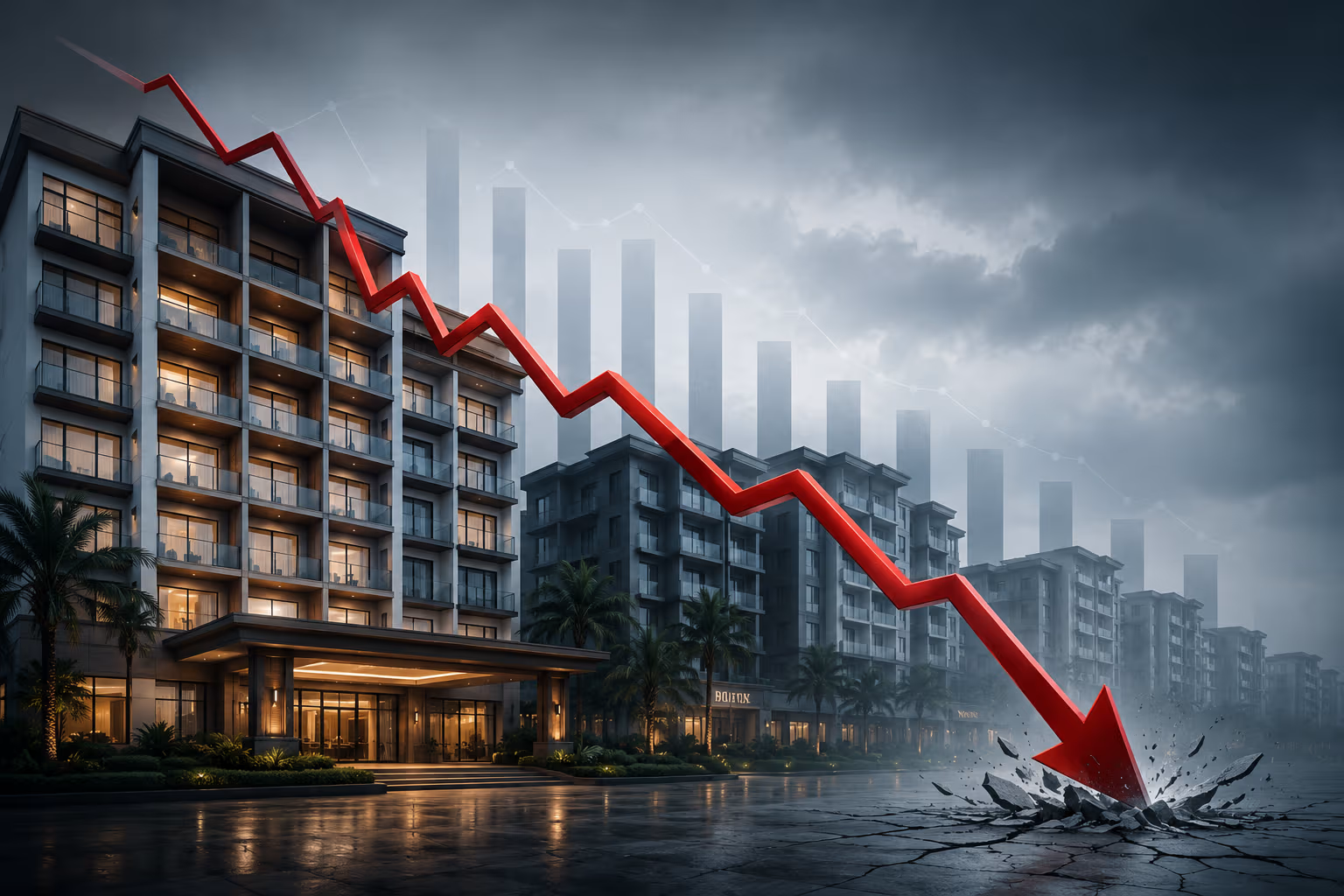


Key Takeaway: A hotel price war doesn't create new travelers in your destination: it forces every property to service the same number of guests for less money, destroying ADR across the entire market while third-party platforms collect their commission on the reduced revenue.
The Thursday Morning That Started a Market Collapse
It's 9:00 AM on a Thursday in Wayanad. A 40-room independent property is trailing its occupancy target for the weekend. The general manager logs into the channel manager and drops the best available rate by 20 percent.
The logic feels sound. Lower the barrier, capture undecided travelers, cover payroll. It seems like doing something.
Within 45 minutes, a competing property three kilometers away gets an alert from its rate shopping software. Its algorithm matches the lower price to protect its search ranking. By early afternoon, three more properties in the competitive set have joined the descent.
The weekend arrives. The original property achieves 65 percent occupancy, exactly what it was already pacing to achieve before Thursday's rate drop. So does the competitor down the road. No new travelers decided to visit Wayanad because rates fell. Overall destination demand remained perfectly static. Every property in the local set simply served the same guests for 20 percent less revenue.
That's a hotel price war. Nobody wins. The only entities that benefit are the OTAs, who collect their standard commission on the now-reduced booking value.
The central question here is not whether to compete on price. It's whether price competition actually works the way operators believe it does, and what the research says about that is uncomfortable.
Why Rate Cuts Rarely Do What Operators Think They Will
The foundational assumption behind dumping rates is that lower prices generate new demand. Research analyzing hotel performance during the 2008 recession and the 2020 pandemic consistently disproves this. Properties that cut rates aggressively did not achieve proportional occupancy gains. They serviced roughly the same volume of travelers at a dramatically reduced margin.
Travel decisions are driven by macro-variables: corporate budgets, school calendars, disposable income, flight connectivity. A local rate drop cannot influence any of these. It only changes how much the already-existing demand pays.
Properties that hold their rate during a slow period and accept slightly lower occupancy consistently outperform discounting competitors on RevPAR over a full quarter. The occupancy gap is small. The ADR gap is large. And margin flows from ADR, not from body count.
This is hotel market degradation: the competitive set finds a lower price equilibrium, and recovering to the prior ADR level takes far longer than the occupancy problem the rate cut was trying to solve.
The Real Mechanics of a Price War
Why the First-Mover Advantage Disappears in Hours
The implicit belief behind a rate cut is that it will be noticed by consumers but missed by competitors. Modern distribution makes this mathematically impossible.
OTA search algorithms surface rates in real time. Automated rate shopping tools notify competitors within minutes. Any price advantage the discounting property gains lasts a matter of hours at most, usually less. By the time guest search behavior shifts toward the lower rate, the entire competitive set has already matched it.
Game theory describes this dynamic precisely through the Bertrand competition model: when firms compete on price in a market with perfect price visibility, a price cut is immediately countered until the market settles at marginal cost. That's not a pricing strategy. That's a race toward zero margin.
What to do: Before authorizing any rate reduction, check whether your own internal booking pace is actually lagging or whether the anxiety is driven by a competitor's move that hasn't yet affected your search velocity. If your pickup for the target date is tracking normally against the prior year, the competitor's drop is irrelevant to your demand picture. Hold the rate.
Why High Occupancy at a Low Rate Can Be a Net Loss
This is the calculation most operators skip. Every occupied room carries a variable cost: housekeeping labor, linen, utilities, guest amenities, and the distribution commission paid to the OTA that sourced the booking. That commission alone typically runs 15 to 25 percent of the booking value.
Consider a 100-room property. At 60 percent occupancy and a $120 ADR, gross operating profit (after $40-per-room variable costs) is $4,800. At 90 percent occupancy and a dumped $75 ADR, gross operating profit is $3,150, despite 50 percent more rooms turned and significantly higher physical wear on the asset.
High occupancy on dumped rates is not a success. It's a more expensive version of failure.
What to do: Calculate your true Cost Per Occupied Room before setting any rate floor. Include channel commission, labor allocation, and consumables. The resulting number is your hard floor. Any rate below it means you're paying to host the guest.
How Algorithms Amplify a Single Panic Decision Across the Market
Many properties now run some form of automated dynamic pricing. The problem with blind rate matching in these systems is that they can't distinguish between a strategic competitor decision and a distressed inventory clearance. When one property drops a rate to close out a cancelled group block, the algorithm sees a market signal and responds accordingly. Neighboring properties' systems respond to that response. The cascade runs automatically.
The original drop was a local anomaly. The algorithmic cascade turns it into a market-wide ADR correction that nobody in the competitive set intended and nobody benefits from.
This is what researchers call phantom demand noise: automated systems interpreting a human panic decision as evidence of structural market weakness, then amplifying it across the destination.
What to do: Configure your revenue management system with a hard algorithmic rate floor. Set a rule that prevents any automated rate recommendation from dropping below your defined minimum without a corresponding trigger in your own internal pace data, not a competitor signal.
Why Discounting Trains Your Best Guests to Leave
The least discussed consequence of repeated rate dumping is what it does to consumer expectations over time. Guests who've booked your property twice at a last-minute discount now understand that your published rate is negotiable. They delay their booking window to force a discount. The property responds to the soft early-window pace by dropping rates, which confirms the strategy.
You've created the booking hesitation you were trying to solve.
Once a market perceives a property as a discount provider, reclaiming the premium position takes years. Guests don't revise upward the reference price they've anchored on. They feel penalized by the return to a standard rate, even if that standard rate was always appropriate for the product.
What to do: Cap your rate variance bandwidth at a maximum of 20 percent below your standard ADR. Inventory that can't sell within that band should sit empty. An unoccupied room costs you nothing in variable expense. A room sold below break-even costs you cash.
A Revenue Week: Holding the Line When Everyone Else Doesn't
A 38-room property in Coorg enters a long weekend with 58 percent occupancy. A competitor has dropped rates 22 percent below the local average. The team wants to match. The revenue manager holds.
Monday: Internal pickup is trailing the prior year by three percent, not a structural failure. Rate unchanged.
Tuesday: Two more competitors join the cascade. A private CUG email goes to 490 past guests: 15 percent member-only rate, behind a login page. Five bookings confirm. No public rate change. No OTA parity flag.
Wednesday: Discounting competitors have cleared most of their OTA availability. The Coorg property is now one of the few showing rooms at a reasonable rate. Organic direct traffic lifts. Three more bookings.
Weekend close: 82 percent occupancy, full ADR, 41 percent direct booking share. Discounting competitors reached similar occupancy at ADR 18 to 22 percent lower with materially higher commission costs. The property won by not joining the cascade.
Why Smart Operators Still Panic and Cut Rates
Understanding the math doesn't prevent the behavioral response. The reason experienced operators continue to dump rates despite knowing the consequences is not a failure of analysis. It's a failure of psychology under pressure.
An empty room is visible. A general manager walks the corridor, sees unoccupied rooms, and experiences immediate, vivid financial discomfort. The degraded ADR showing up in next month's P&L is abstract and delayed. The brain responds to the vivid, present loss long before it registers the invisible future one.
This is loss aversion in real time. The psychological pain of a potential loss is significantly more intense than the pleasure of an equivalent gain. Empty rooms on a Tuesday afternoon override the mathematical case for holding rates.
The second mechanism is status quo bias in ownership expectations. Occupancy is the metric most ownership groups ask about first. A GM showing 90 percent occupancy at compressed margins has an easier meeting than one explaining an 8 percent occupancy dip alongside a 14 percent ADR gain. Until ownership shifts evaluation toward GOPPAR, managers will keep making rate decisions that satisfy the metric they're actually judged on.
What Independent Properties Should Do This Week
Calculate your true rate floor. Add up housekeeping labor, utilities, consumable amenities, and OTA commission per occupied room. That total is the absolute floor. Any rate below it means the booking costs you money.
Set a hard algorithmic floor in your channel manager. Configure your software so no automated recommendation can push a rate below your floor. Remove the system's ability to blind-match competitor drops.
Build a private CUG offer before the next slow period. A 15 percent discount behind an email login doesn't touch your public rate, doesn't trigger a parity flag, and doesn't signal weakness to OTA algorithms.
Remove panic pricers from your compset. If one property consistently drops rates irrationally, exclude it from your rate shopping view. Irrational actors distort the data you're making decisions from.
Reframe the occupancy conversation with ownership. Bring the GOPPAR comparison to the next review: 60 percent occupancy at full rate versus 90 percent on dumped rates. Make the margin argument visible before the pressure to discount arrives.
The Bottom Line: Hold the Rate or Hand Over the Margin
The room that sits empty on a Wednesday night costs you nothing in variable expense. The room sold below break-even costs you cash.
Dumping rates doesn't create travelers, steal lasting market share, or solve structural demand problems. It redistributes existing revenue downward across the competitive set and trains guests to wait for the next discount cycle.
Hotel market degradation isn't something that happens to markets. It's something properties do to themselves, one panicked Thursday morning at a time.
Two things to implement this week:
-
Set your rate floor in every active channel before the next soft period hits, not during it. The decision made under calm conditions is always better than the decision made when occupancy looks frightening at noon on a Thursday.
-
Run the GOPPAR comparison for your last three slow weekends: what did each sell at, what was the true variable cost per occupied room, and what was the actual margin per room turned? The resulting number is the cost of the last price war you participated in.
Ready to build a hotel price war defense and rate integrity strategy tailored to your property? Grow Engine works with independent properties across India and globally to implement revenue management systems that fit your market, your guests, and your goals. Get in touch today through https://www.growengine.in.