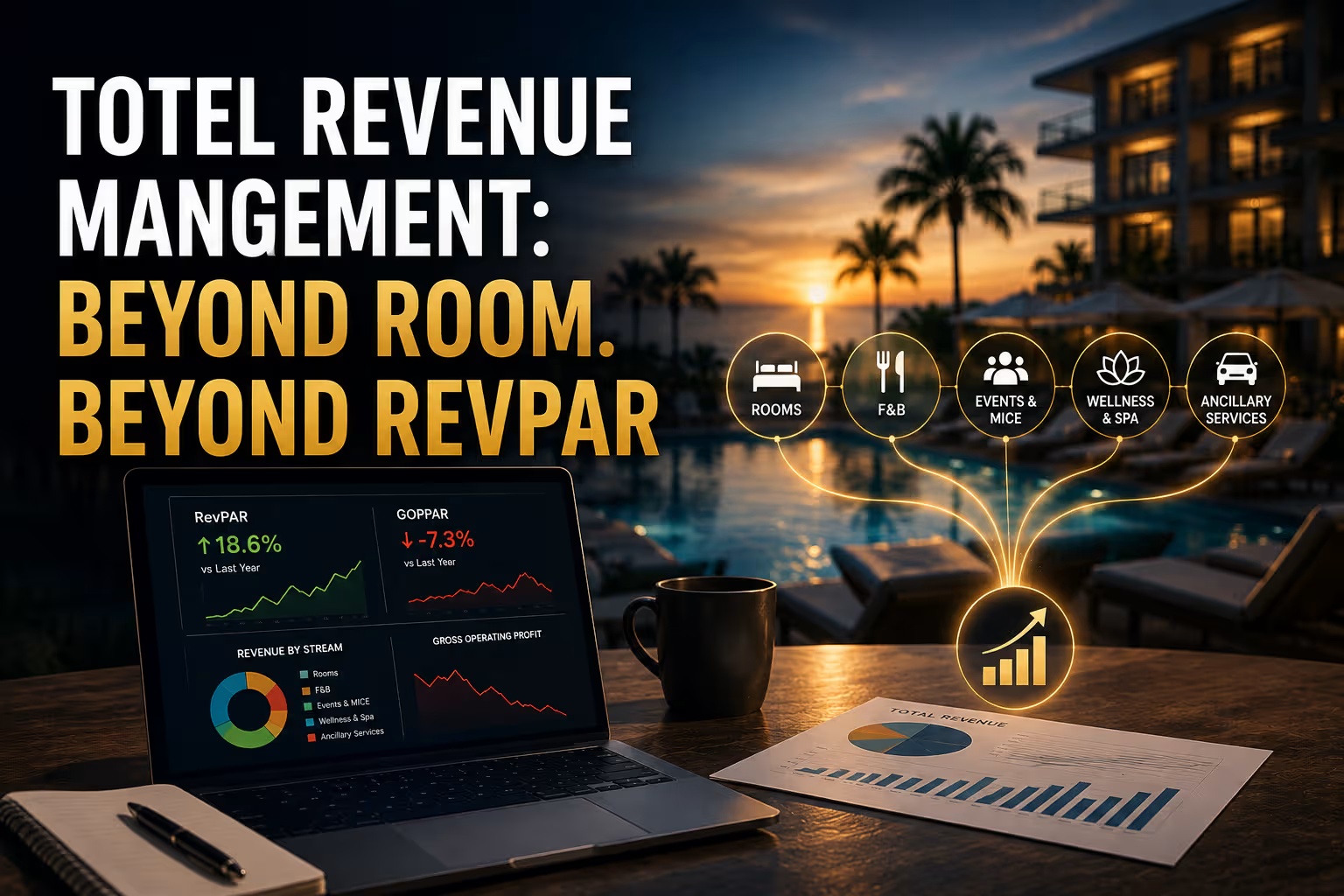


Key Takeaway: Maximizing true property profit requires abandoning isolated departmental metrics and restructuring executive compensation around shared financial health, ensuring every team member is financially motivated to execute your pricing strategy.
Building a Hotel Revenue Culture: Cross-Department Revenue and Front Desk Upselling
Picture this. It is 48 hours before a major long weekend. You are managing a beautiful 60-key property in Goa. Your Revenue Manager looks at the pacing data, sees high market compression, and aggressively raises room rates to protect your overall yield. Mathematically, it is the perfect move. But down in the physical lobby, the strategy completely shatters.
The sudden rate spike mathematically drops your physical occupancy, leaving the Food and Beverage Director staring at an empty dining room and missing their daily cover targets. Meanwhile, the arrival agents are dealing with angry walk-ins and refusing to offer premium suites because the new rate codes are far too complex to explain quickly.
Building a highly profitable hotel revenue culture means stopping this exact scenario. When departments fight each other, profits bleed out of the building. Take a look at a competing property in Jaipur facing the exact same long weekend. Their food and beverage team thrives on lower occupancy because they track revenue by time and capacity rather than sheer volume. Their agents excel at front desk upselling because they earn a direct, transparent commission on every premium room they secure. They generate massive cross-department revenue while the Goan property fights bitterly over internal budgets.
Why do smart operators with access to the exact same market data make such completely different decisions when the pressure hits?
The Operational Fracture: Why Textbook Pricing Algorithms Fail in the Lobby
The foundational literature of commercial property management preaches the absolute necessity of holistic profit tracking. You have the software. You track the data. You understand that maximizing Gross Operating Profit Per Available Room is the only true measure of financial health. Yet, the textbook algorithmic approach consistently fractures upon contact with human operational reality.
The core issue is not a lack of market data or poor software logic. The breakdown happens entirely because different department heads are judged on isolated, conflicting metrics.
Consider the daily reality of your executive committee. Your Revenue Manager is celebrated and bonused for hitting top-line room targets and beating the local market penetration index. But your Food and Beverage Director is judged almost entirely on food cost percentages and total daily covers. If the Revenue Manager aggressively raises rates during a peak day and occupancy drops, they still hit their room revenue budget. The Food and Beverage Director, however, fails their budget completely because a lower physical head-count in the building means fewer restaurant covers.
Because these leaders lack a unified technological dashboard and fight for their own departmental survival, they develop a natural hostility toward holistic pricing strategies. Standard algorithms assume your property management system and your point of sale system communicate flawlessly. In a theoretical world, the Revenue Manager sees that a specific guest segment spends heavily in the restaurant, justifying a lower room rate to capture that exact demographic. In reality, these systems at independent properties are entirely disconnected, requiring hours of manual data reconciliation. You cannot build a unified operational strategy if your leadership team is financially motivated to pull in opposite directions.
The Profit-Oriented Alignment Framework
To fix this operational fracture, properties must engineer the friction out of their internal systems. The following framework provides specific methods to align your departments and drive true net profit.
1. Restructuring Executive Compensation
The Specific Problem: Departmental tribalism destroys your pricing strategy. Executives relentlessly protect their specific silos to secure personal bonuses, leading to severe hostility when pricing decisions lower overall property footfall.
Why This Solution Works: Blending specific operational metrics with property-wide gross operating profit forces leaders to care about total financial health rather than isolated numbers.
Real-World Intuition: If a food and beverage director only cares about total daily covers, they will resent the revenue manager for raising rates and lowering occupancy. If half their bonus depends on the whole property making money, they will actively support the higher rates because the net profit increases.
Implementation Advice: Restructure all executive bonuses so 50 percent is based on departmental performance and 50 percent is tied directly to property-wide gross operating profit per available room.
2. Shifting Food and Beverage Focus to Time and Capacity
The Specific Problem: Evaluating restaurants purely on average check size or total covers ignores the physical reality of peak dining hours and limited seating capacity.
Why This Solution Works: Tracking revenue against both physical seats and opening hours forces the team to optimize table turns and meal durations when demand is at its absolute highest.
Real-World Intuition: A team judged strictly on total covers might allow a low-spending guest to occupy a premium table for three hours. Optimizing for time ensures you capture the highest value guests during the most compressed dining windows.
Implementation Advice: Transition your primary performance tracking to Revenue Per Available Seat Hour by integrating your point of sale system to track exact seating durations.
3. Decoupling Base Rates from Incremental Upgrades
The Specific Problem: Agents avoid selling room upgrades because property management system rate codes are terrifyingly complex. Altering them risks breaking virtual credit card payments or violating rate parity rules.
Why This Solution Works: Treating upgrades as flat add-on fees bypasses complex rate-code alterations entirely, removing the fear of administrative mistakes.
Real-World Intuition: Think about airline gate agents. They process baggage fees and priority boarding without rewriting your entire original ticket. Property systems must offer that same frictionless experience for the agent.
Implementation Advice: Engineer distinct, fixed transaction codes within your software that act as flat incremental fees, ensuring the original booking data remains fully intact and secure.
4. Bypassing Algorithmic Retaliation with Conversational Commerce
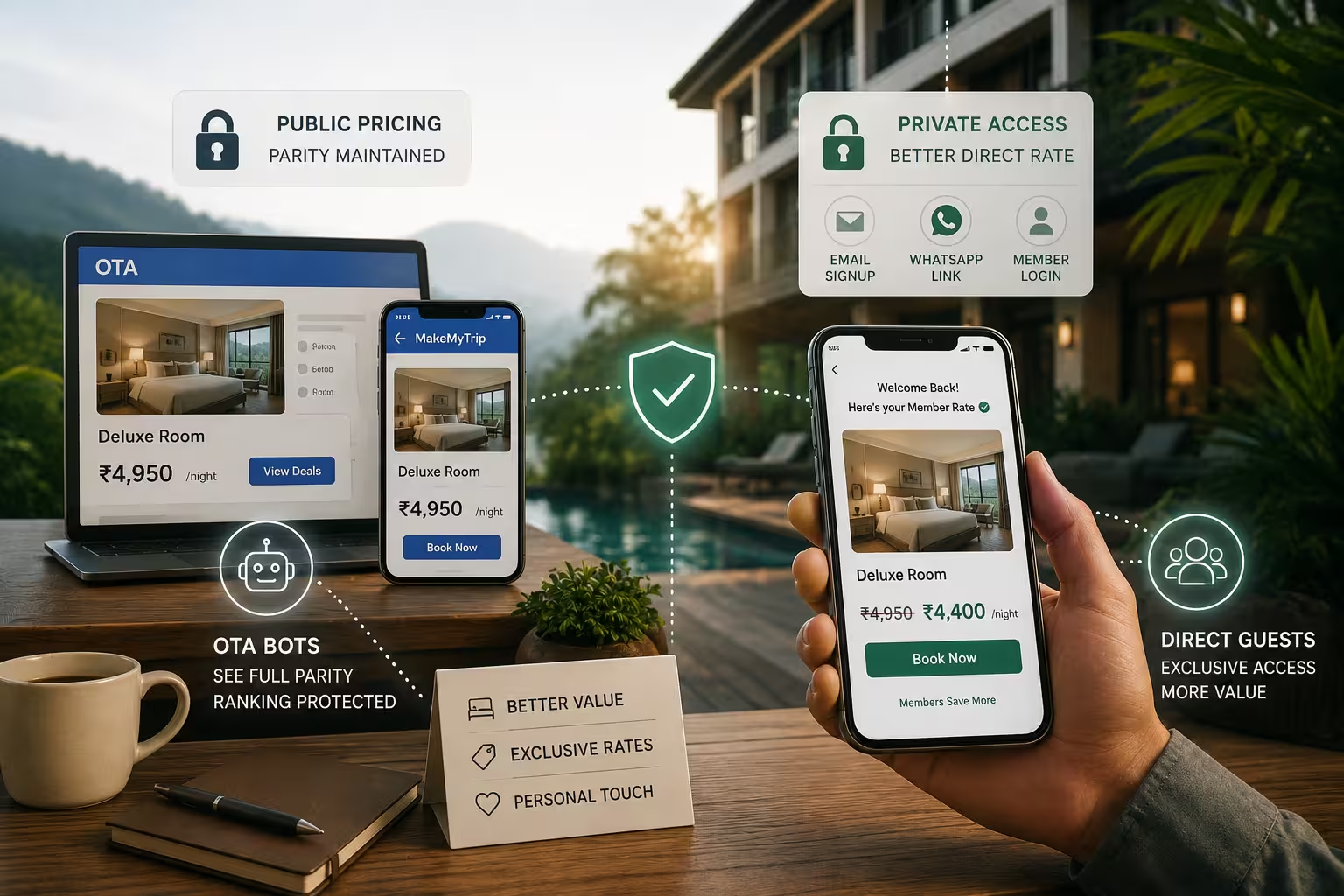
The Specific Problem: Operators fear major online travel agencies will penalize their search ranking if they offer lower rates directly. Consequently, properties accept massive commission leakage and force users into clunky web booking engines.
Why This Solution Works: Publishing closed user group rates via WhatsApp exploits recent regulatory rulings protecting rate parity, meeting the mobile-first consumer exactly where they prefer to negotiate and buy.
Real-World Intuition: The modern consumer wants to negotiate and build trust through a conversation, not a static web form. If you force them into a long online checkout, they will abandon the cart and return to the travel agency for the perceived safety of a simple payment flow.
Implementation Advice: Route all website traffic directly to a WhatsApp pipeline to capture direct bookings seamlessly via instant payment links, reclaiming the 15 to 25 percent commission margin to directly fund property operations.
Executing the Strategy: A Peak Season Pacing Scenario
Imagine a boutique property in Manali tracking booking pace three weeks ahead of a major season rush. The pickup report shows occupancy is surging much faster than historical averages. The commercial algorithm immediately suggests a massive rate increase for the remaining standard rooms.
Under an old, fractured system, this creates pure chaos. Housekeeping panics about turning over that many rooms in a tight window. The front desk braces for arguments about early check-in fees because the rooms simply will not be clean in time. But under an aligned framework, the execution looks entirely different.
Because executive bonuses are tied to property-wide profit, the Revenue Manager consults directly with Housekeeping. They realize that pushing for 100 percent occupancy with one-night stays will skyrocket the cost per occupied room due to massive laundry and labor expenses. Instead, the Revenue Manager implements a strict three-night minimum length of stay restriction for the peak dates. Occupancy mathematically drops to 75 percent, but the average length of stay jumps to 3.5 nights.
Simultaneously, a similar property in Darjeeling shifts its front desk into action. Because upgrades have been decoupled from complex rate codes and the agents are motivated by a clear commission structure, they confidently offer premium suites to arriving guests. Housekeeping turns fewer rooms but with much higher efficiency. By focusing on the net bottom line instead of pure volume, both properties increase their gross operating profit significantly while drastically reducing physical wear and tear on the staff.
The Synthesis Conflict Table: Navigating Human Behavioral Frictions
Even with the right framework in place, human psychology often derails commercial strategy. You cannot master cross-department revenue without addressing the specific biases found in the Synthesis Conflict Table that cause your management team to panic.
First, consider loss aversion and the vividness bias. As a peak day approaches, a General Manager looking at ten physically empty rooms feels an intense, visceral panic. The pain of visualizing a perishable room night going unsold feels much heavier than the logical discipline of holding the optimal rate. This triggers emotional panic discounting 48 to 72 hours before arrival. The manager slashes rates just to capture baseline occupancy. The market quickly learns to wait for your distress sales, permanently eroding your pricing power and brand equity.
Second, look at the anchoring bias during transactions. When a guest books a room for 5,000 rupees online, that exact number becomes their psychological anchor. If your agent tries to sell a premium suite by stating the new total is 7,500 rupees, the guest perceives a massive financial leap and instantly rejects the offer. To bypass the guest's loss aversion, the financial leap must be framed as a minor, incremental investment rather than a major purchase.
Finally, there is the principal-agent problem. The owners and general managers aim to maximize total revenue through dynamic pricing and aggressive sales strategies. The agents and housekeeping staff are tasked with executing these strategies. However, the agents are compensated via flat hourly wages or fixed salaries. Consequently, the agents have no inherent financial incentive to maximize yield.
When you command your team to enforce late check-out fees or capture walk-ins at maximum rates, you are asking the agent to absorb all the emotional friction and rejection risk of a sales transaction, while you keep all the financial reward. Their rational economic behavior is to simply avoid the friction, clear the queue quickly, and give away premium rooms for free to keep demanding guests happy. Unless the agent receives a transparent, immediate reward that outweighs the psychological pain of rejection, they will systematically bypass the revenue-generating action.
5 Steps to Execute Profit-Oriented Alignment This Week
To bridge the gap between theoretical math and human operations, execute these five specific directives.
| Step | Action | Details |
|---|---|---|
| 1 | Institute a 48-Hour Rate Override Lockdown | Require documented, multi-party executive approval to drop public rates close to arrival to prevent emotional panic discounting |
| 2 | Launch a Transparent Front Desk Commission | Offer a flat 5 to 10 percent payout on all realized incremental revenue (early check-ins, room upgrades), paid as a distinct line item on paychecks |
| 3 | Mandate Marginal Rate Framing Scripts | Train agents to quote only the incremental upgrade cost (for example, "For just 2,500 rupees extra, you can enjoy our premium suite") rather than the total revised room rate |
| 4 | Publish Closed User Group WhatsApp Rates | Exploit recent regulatory parity rulings by offering exclusive rates via WhatsApp that slightly undercut major platforms, routing website traffic to a direct pipeline |
| 5 | Deploy Automated Digital Storefronts | Implement a pre-arrival communication system that triggers automated upgrade offers 72 hours before check-in, removing the transaction bottleneck from the physical lobby |
Conclusion
Here is the hard truth about building a resilient hotel revenue culture: selling out your property might actually be destroying your net profit.
Traditional industry logic celebrates 100 percent occupancy as a total victory. But if you fill your property with one-night, heavily commissioned bookings, your cost per occupied room skyrockets. Every single room requires a full housekeeping turn, fresh linens, and administrative processing time. An independent property operating at a quiet 75 percent occupancy with a higher average length of stay and a healthy direct booking mix will generate significantly higher net profit than a sold-out property churning through daily turnovers. Real cross-department revenue requires looking past top-line volume to see the true physical cost of every booking. You must align the math with the human behavior executing it, from housekeeping workflows to front desk upselling.
Take these exactly two actions this week:
-
Calculate your true cost per occupied room and establish a firm minimum length of stay restriction for your next projected peak period.
-
Strip one generic room upgrade task from your manual lobby operations and automate it via an email or messaging campaign exactly 72 hours prior to arrival.
Ready to build a Pricing Strategy tailored to your property?
Grow Engine works with independent properties across India and globally to implement revenue management systems that fit your market, your guests, and your goals. Get in touch today.