

Key Takeaway: Distressed inventory should be sold quietly through opaque channels at a calculated floor, not broadcast publicly at a discount that trains your entire market to wait you out.
The Thursday Afternoon Panic Discount
It is Thursday afternoon at a 45-room independent property in Coorg. Heavy monsoon rain has just been forecasted for the weekend. Three corporate offsites cancel within an hour of each other, and occupancy is sitting at a bleak 40% for Friday and Saturday.
The general manager's instinct is immediate: drop the public Best Available Rate (BAR) by 30% across every OTA extranet and hope demand fills the gap before the weekend arrives.
This is the single most common, and most expensive, mistake in independent hotel pricing. A public rate cut does not stay contained. OTAs stack their own loyalty discounts on top of it, metasearch engines index the lower number within hours, and guests who booked a month earlier at full rate now see a property selling for less than a roadside budget stay. The damage to brand trust outlasts the weekend by months.
There is a better way to move the same distressed rooms without anyone outside your channel manager ever seeing the discount. It is called hotel opaque pricing, and used correctly through a modern Hotwire hotel strategy or a fixed-rate successor to classic Priceline bidding, it clears empty rooms while keeping your public rate exactly where it belongs.
Why Public Discounting Quietly Destroys More Than It Saves
When a property slashes its public BAR to chase occupancy, the assumption is that a lower price simply opens the door to a new tier of price-sensitive guests. In practice, it triggers something closer to a chain reaction.
OTAs frequently stack their own member discounts on top of a newly lowered base rate, so a property that dropped its rate by 30% can end up displayed at closer to 40 or 45% off once loyalty pricing is applied. Metasearch platforms detect the new low almost instantly, and if the direct booking engine does not immediately match it, direct conversion collapses and nearly every booking that comes through the door now carries an 18 to 25% OTA commission on top of the discount.
The deeper problem is that a public rate cut does not discriminate between guests. Everyone booking at that price gets the same rock-bottom rate, including the corporate traveler or leisure guest who was fully willing to pay full retail. Occupancy goes up while Gross Operating Profit Per Available Room (GOPPAR) quietly collapses, because every room sold is now sold at close to Cost Per Occupied Room (CPOR) with almost no margin left over.
Opaque channels solve this by hiding the property's identity until after payment. The guest sees a star rating, a general neighborhood, and a price, nothing that reveals which specific property they are booking. This lets a premium property sell to a price-sensitive, brand-agnostic traveler without ever putting that discount in front of the loyal, full-rate guest. It is worth noting that the classic live-bidding version of this, where guests submitted an open Priceline bidding offer for a property to accept or reject, was discontinued in 2020. Today's opaque volume runs almost entirely through fixed-price formats like Priceline Express Deals and Hotwire Hot Rates, which are far easier for an independent property to control.
A Working Framework for Opaque Channel Pricing
| Rule | Detail | Why It Matters |
|---|---|---|
| Calculate floor using CPOR | Room cost + housekeeping + OTA commission + 10-15% margin | Prevents selling at a loss; never below cost |
| Fence the booking window | Open opaque only after 85% of normal demand confirms | Ensures discount reaches only distressed inventory |
| Route through channel manager | Auto-sync via SiteMinder, Cloudbeds, or AxisRooms | Prevents parity errors and manual overbookings |
| Cap opaque volume | Stop at ~15% of total room mix over 30 days | Keeps discount channel from becoming core demand |
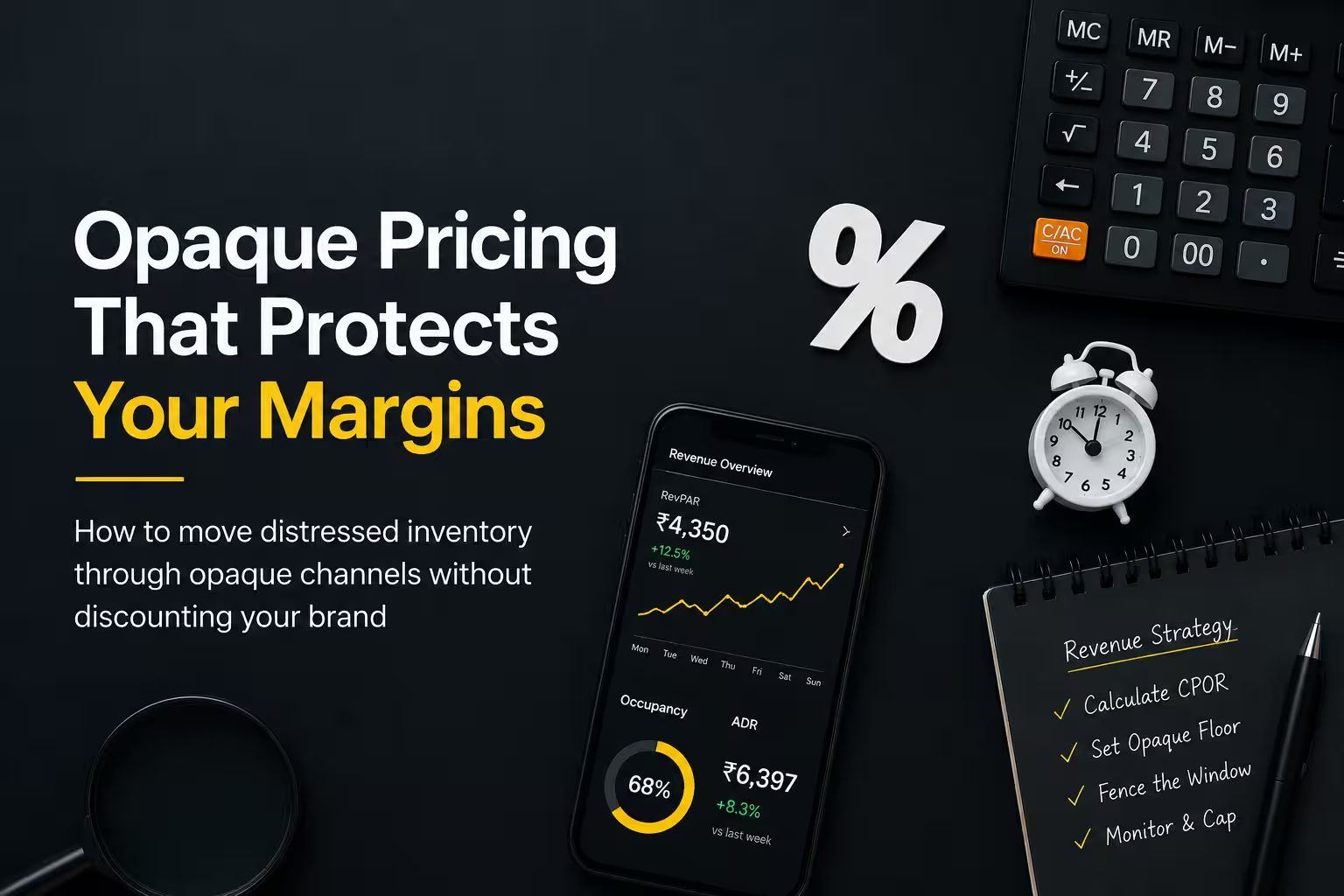
Calculate your absolute floor using CPOR, never a gut-feel discount. Start with your actual Cost Per Occupied Room, adding up housekeeping labor, laundry, utilities, guest amenities, and OTA commission on that specific booking. If your CPOR comes to roughly ₹1,540 per room, your opaque floor should be that number plus a fixed target margin, commonly 10 to 15%. Anything sold below that number means you are effectively paying the guest to stay.
Fence the booking window so opaque never competes with full-price demand. Opaque pricing is for inventory that will otherwise go unsold, not a permanent discount channel. Check how early your normal demand books in. If 85% of your weekend business is typically confirmed by Wednesday, open the opaque channel no earlier than Thursday morning. Opening it further out simply hands a discount to guests who would have paid full rate anyway.
Route the rate through your channel manager, never manually. Manual updates on individual OTA extranets are where parity errors and accidental overbookings happen. Push your opaque floor rate through a centralized channel manager such as SiteMinder, Cloudbeds, or AxisRooms, with Availability, Rates, and Inventory synced dynamically, so the feed switches off automatically the moment normal demand recovers.
Cap opaque volume and monitor it monthly. If bookings from Hot Rates or Express Deals climb past roughly 15% of your total room mix over a rolling 30-day period, either your discount is too deep or your window is open too wide. Opaque channels exist to clear the edges of your inventory, not to become the core of your demand base.
How This Plays Out Over a Real Weekend
Back to that Thursday afternoon in Coorg. Instead of dropping the public BAR, the revenue manager pulls up the CPOR calculation: ₹1,540 per room, plus a 15% margin, giving an opaque floor of roughly ₹1,770.
By Thursday evening, that floor rate is live on Hotwire Hot Rates and Priceline Express Deals, routed through the property's channel manager, with the public BAR on Booking.com and the direct site untouched at ₹4,500.
Friday morning, six of the eighteen soft rooms have booked through the opaque channel at the calculated floor, covering variable costs with margin to spare. The public rate has not moved, so the guests who booked three weeks earlier at full price never see a lower number appear.
By Saturday, weather clears faster than forecast and walk-in leisure demand picks up. Because the channel manager was synced dynamically, the opaque feed shuts off automatically once occupancy crosses the property's threshold, protecting the remaining rooms for full-rate sale. The weekend closes with occupancy recovered, margin intact on the majority of rooms sold, and zero damage to the property's public rate integrity.
The Bottom Line
Distressed inventory is unavoidable in hospitality. What separates properties that protect their pricing power from properties that erode it is not whether they have empty rooms sometimes, it is how they choose to sell them. A quiet, calculated opaque rate clears the same rooms as a public discount without training your market to wait for one.
Two things you can do this week:
- Calculate your true CPOR for a standard room and set a hard opaque floor rate before your next soft weekend forecast, instead of reacting with a public BAR cut.
- Fence your opaque booking window to open no earlier than the point where your historical data shows normal demand has already booked in.
Ready to build an opaque pricing strategy tailored to your property? Grow Engine works with hotels across India and globally to implement revenue management systems that fit your market, your guests, and your goals. Get in touch with us today.