

Key Takeaway: In an inflation environment where ADR growth is running below 2% while operating costs climb above 3%, the hotels that protect margins are not the ones raising rack rates blindly -- they are the ones using value-anchored pricing, smarter channel mix, and real demand data to justify every rupee they charge.
The Owner Who Kept Rates Low to "Stay Competitive"
It was October. A 52-room property in a mid-tier Indian city had just wrapped its best occupancy month in three years -- 81% average across the month. The owner was pleased. The accountant was not.
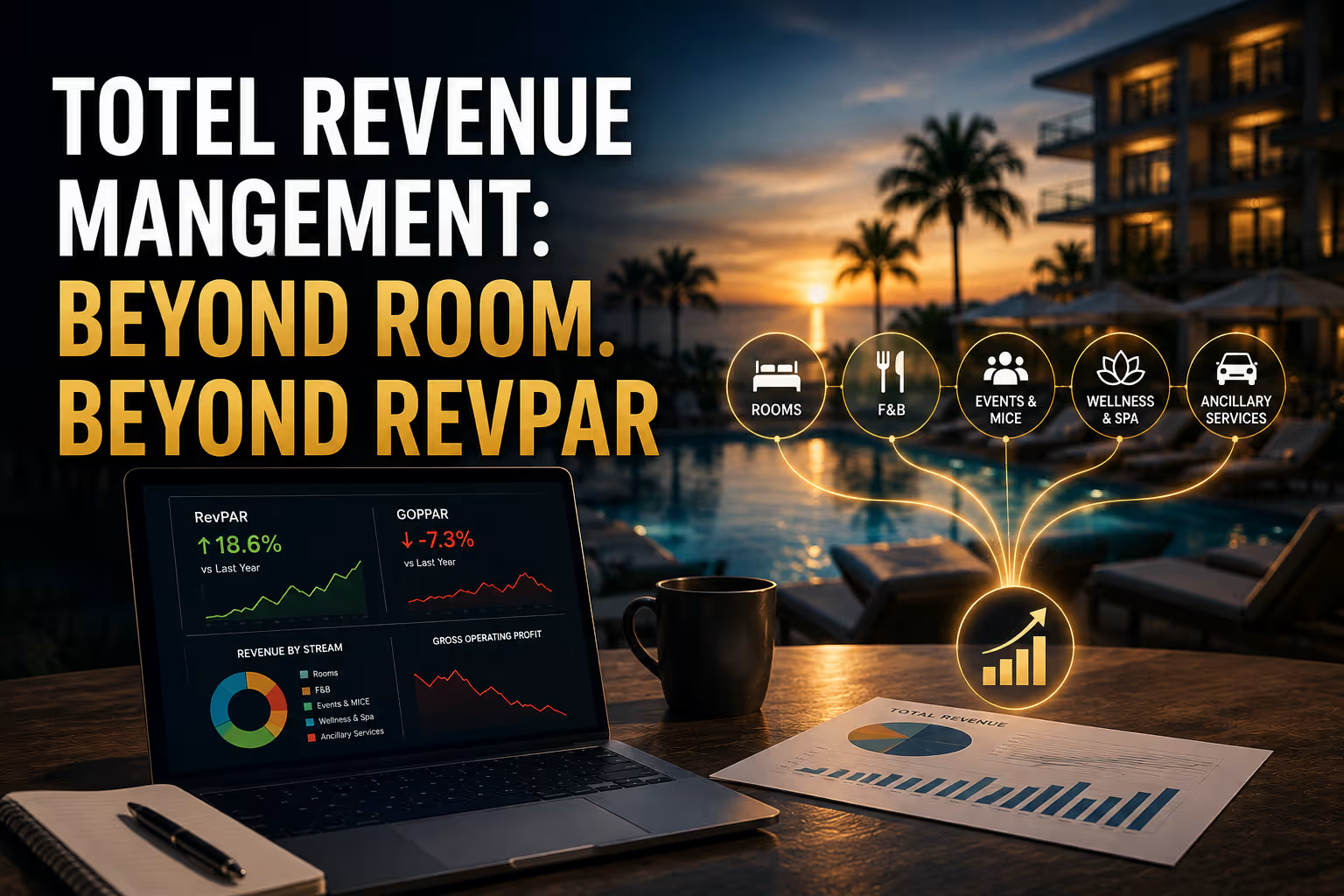
Energy bills had climbed 18% year-on-year. Housekeeping wages were up 14%. Laundry and supplies costs had crept up quietly across every quarter. And yet the hotel's ADR had moved from ₹3,800 to ₹3,950 -- a 3.9% nominal increase that looked reasonable on a dashboard but meant nothing in real terms once costs were factored in. Gross operating profit had actually declined by 7% versus the same month the prior year, despite stronger occupancy.
The owner's instinct had been to hold rates steady to avoid losing guests to competitors. That instinct is understandable. It is also, in an inflationary environment, precisely how hotels quietly erode the financial foundation they spent years building.
This is the core challenge of hotel pricing inflation: operating costs move fast, guest price sensitivity is real, and the gap between the two requires a deliberate hotel rate strategy -- not a passive one. Revenue management inflation is not a macro problem to wait out. It is a margin problem to solve today, with the tools and tactics available right now.
Why Holding Rates Flat Is the Most Expensive Decision You Can Make
The instinct to hold rates during inflationary periods feels like prudent guest management. In practice, it is a slow leak.
The OECD projects global inflation will average 3.2% in 2026. STR and Tourism Economics put U.S. ADR growth at roughly 1.0% to 1.4% for the same year. The arithmetic is unforgiving: when your rates grow at 1% and your costs grow at 3%, you are running a business that becomes less profitable with every booking, regardless of how full the hotel is.
Real ADR -- your average daily rate adjusted for inflation -- is the metric that reveals this gap. A hotel that achieved ₹4,200 ADR in 2024 and ₹4,280 ADR in 2026 has not kept pace with a 6% cumulative cost increase over two years. Its real ADR has declined. RevPAR may look stable. GOP is not.
The structural problem is compounded by three converging pressures that HVS identified in their 2026 profitability analysis. Labour now represents 47-60% of operating expenses by region and is not a flexible line item. Insurance premiums and utility costs have risen persistently since 2022. And ADR -- the lever that historically absorbed cost growth -- is no longer working as a profitability buffer the way it did in 2022 and 2023 when post-pandemic demand gave hotels unusual pricing power.
The answer is not to raise rates indiscriminately. Guest price sensitivity is real, particularly in the economy and mid-market segments. A CWT/GBTA forecast confirms corporate hotel rates are expected to rise just 1.8% globally in 2026 -- meaning corporate accounts will resist aggressive rate increases. The answer is to be deliberate and strategic: raise the perceived value of the rate rather than simply raising the number, and use pricing architecture to protect ADR without triggering cancellations or booking avoidance.
Four Strategies to Raise ADR Without Alienating Guests
| Strategy | Key Action | What It Prevents |
|---|---|---|
| Shift to value-anchored pricing | Bundle low-cost add-ons (late checkout, F&B credit) into a "BAR Plus" rate | Guest resistance to bare rate increases |
| Protect rate floor | Use non-refundable, advance-purchase, and LOA fences instead of public cuts | Rate discount addiction and parity violations |
| Time rate moves to demand signals | Anchor increases to booking pace and competitor availability | Cost-push pricing that ignores market willingness |
| Shift channel mix to direct | Invest in booking engine, Google Hotel, rate match guarantee | 15-25% OTA commission compounding as costs rise |
-
Shift from rate increases to value-anchored pricing. A ₹500 rate increase presented as a bare number invites resistance. The same increase packaged as a late checkout, welcome amenity, and complimentary breakfast is absorbed far more easily because the guest perceives they are getting more, not simply paying more. This is the single most effective hotel rate strategy in an inflationary period: reframe the price by increasing what it visibly includes. Identify two or three low-cost, high-perception additions your property can bundle into a "Best Available Rate Plus" offer. Early check-in and a F&B credit cost you marginally more in marginal terms but justify a 10-15% ADR premium with a meaningful proportion of your guests. Expedia data shows 98% of hotels lost revenue last year to rate parity violations -- guests who found lower rates on third-party channels than directly. Fix rate parity first, then build value on top of your corrected rate floor.
-
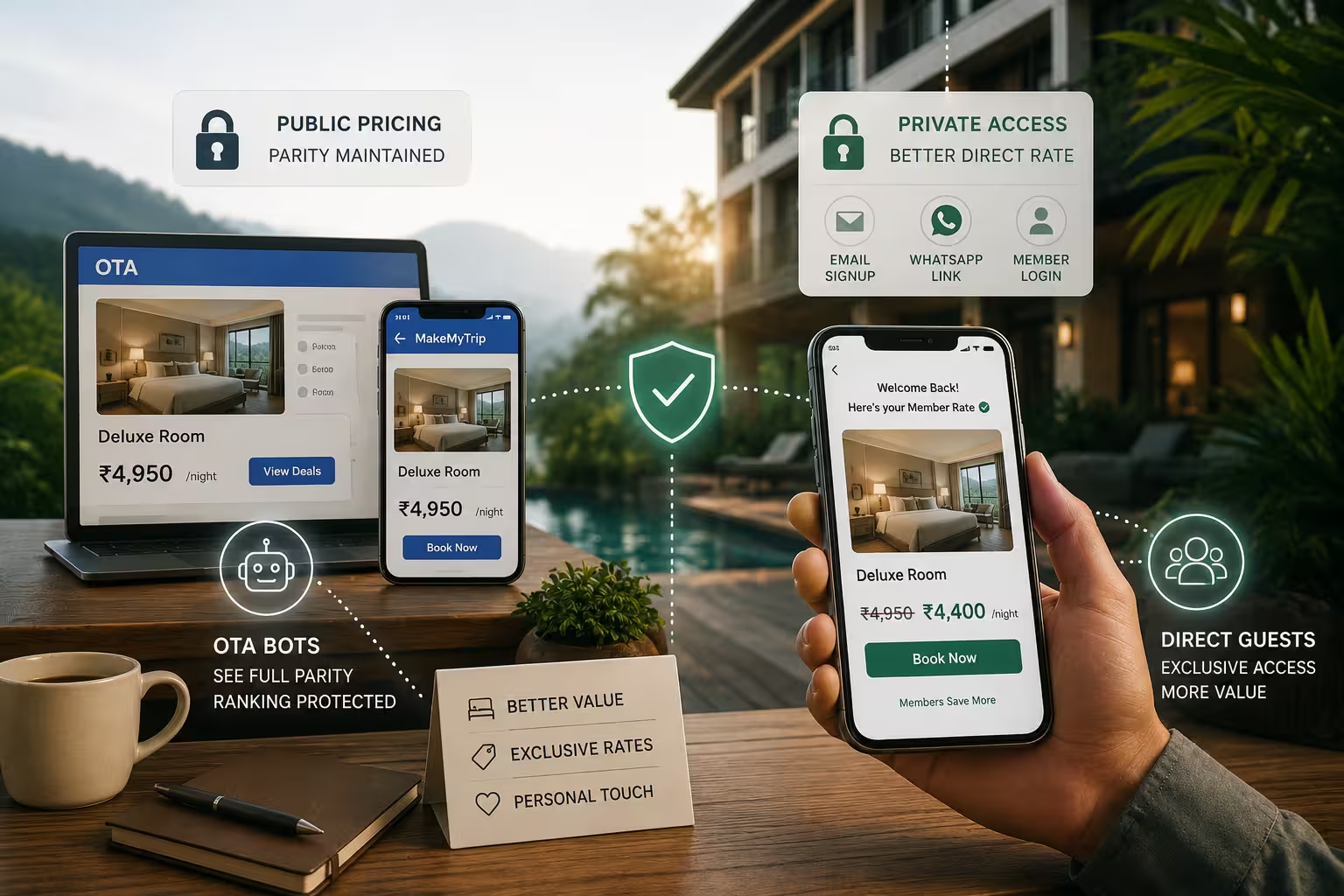
Protect your rate floor by resisting blanket discounting. The reflexive response to soft mid-week occupancy during an inflationary period is to drop rates. This is almost always the wrong move. When you cut rack rates publicly, you train price-sensitive guests to wait for discounts, you undermine the confidence of guests who booked at full rate, and you compress your ADR in the periods that matter most. Instead, use fenced offers: non-refundable advance purchase rates (available only 21+ days out), member-only rates on your direct booking channel, and length-of-stay packages that reward multi-night bookings without broadcasting a lower rate to the market. Revenue management inflation discipline means protecting your published rate while creating structured pathways for price-sensitive segments to self-select into lower-margin inventory.
-
Use real demand data to time rate moves -- not cost pressures. The worst pricing decisions in inflationary periods happen when operators raise rates because their costs went up, not because demand supports a higher price. Guests do not care about your electricity bill. They care about what they can get at a comparable property for the same price. Your rate increases must be anchored to demand signals: forward booking pace, local event calendars, competitor availability, and occupancy thresholds. If you are at 72% occupancy for a date that is 14 days out and your two nearest competitors have each dropped below five rooms available, that is a demand signal. Raise the rate. If you are at 42% occupancy with no demand drivers visible, add value rather than adding cost. AI-driven RMS tools are now accessible from a few hundred dollars per month for independent properties and deliver 15-20% RevPAR improvements precisely because they make these demand-signal decisions in real time, not once a week.
-
Shift your channel mix to lower acquisition cost. OTA commissions of 15-25% are a fixed cost that compounds in an inflationary environment. A room sold at ₹4,500 through an OTA nets approximately ₹3,600 after an 18% commission. The same room sold directly nets ₹4,500 minus a minimal payment processing fee. In practical terms, shifting 10 percentage points of your booking mix from OTA to direct on a 40-room property running 70% annual occupancy adds roughly ₹30-40 lakh in net annual revenue with no change to your rack rate at all. Invest in a credible direct booking channel -- an optimised Google Hotel profile, a functional booking engine, and a rate match guarantee -- and treat it as a permanent inflation-mitigation strategy, not a temporary campaign.
A Practical Three-Week Reset: One Hotel's Approach
| Week | Focus | Action | Result |
|---|---|---|---|
| Week 1 | Rate parity fix | Audit all OTA rates vs direct booking engine; correct 3 parity leaks; activated heritage tour + late checkout direct incentive | Raising floor rate across channels |
| Week 2 | Demand-driven pricing | Built occupancy-based rate ladder; moved fair/event dates to higher tier; activated 12% non-refundable advance rate | Forward booking acceleration |
| Week 3 | Private channel stimulation | "Stay 3, Pay 2" package via email to past guests only — no public listing | Shoulder-night occupancy without BAR dilution |
The results over the following 30 days: direct booking share moved from 28% to 41%. ADR on direct bookings averaged ₹4,620 versus ₹3,890 on OTA channels. Blended ADR for the month rose 9.3% against the prior comparable period. GOP margin, which had been declining for three consecutive quarters, improved by four percentage points.
No rate was raised arbitrarily. Every pricing move was anchored to either a demand signal or a value addition the guest could see and appreciate.
The Bottom Line: Inflation Is a Margin Problem, Not a Rate Problem
The hotels that navigate inflationary periods successfully are not the ones that raise rates the most aggressively or the ones that discount most defensively. They are the ones that understand the real cost of every booking -- factoring in acquisition cost, channel commission, and occupancy pattern -- and price accordingly.
Hotel pricing inflation is not a single decision. It is a daily discipline. Real ADR, not nominal ADR, is the number that tells you whether your pricing is keeping pace with your cost base. Revenue management inflation strategy means protecting your rate floor, building value into your pricing architecture, and shifting distribution mix toward lower-cost channels consistently over time.
Take two actions this week to begin closing the inflation gap:
-
Calculate your real ADR. Take your current ADR and subtract your total year-on-year cost increase percentage. If your ADR grew 3% but costs grew 6%, your real ADR declined by 3%. Knowing this number precisely makes the case internally for rate action and gives you a clear target: at minimum, your ADR growth must outpace your blended cost increase annually to maintain margin stability.
-
Audit your rate parity across every channel. Log in to your three highest-volume OTA listings and compare the displayed rate against your direct booking engine for the next 30 days. If any OTA is showing a lower rate than your own website, you have a rate floor leak that is costing you direct booking revenue and depressing your blended ADR simultaneously. Fix it this week before any other pricing initiative.
Inflation does not wait. Neither should your hotel rate strategy.
Ready to build a hotel pricing inflation and revenue management strategy tailored to your property? Grow Engine works with hotels across India and globally to implement revenue management systems that fit your market, your guests, and your goals. Get in touch with us today.