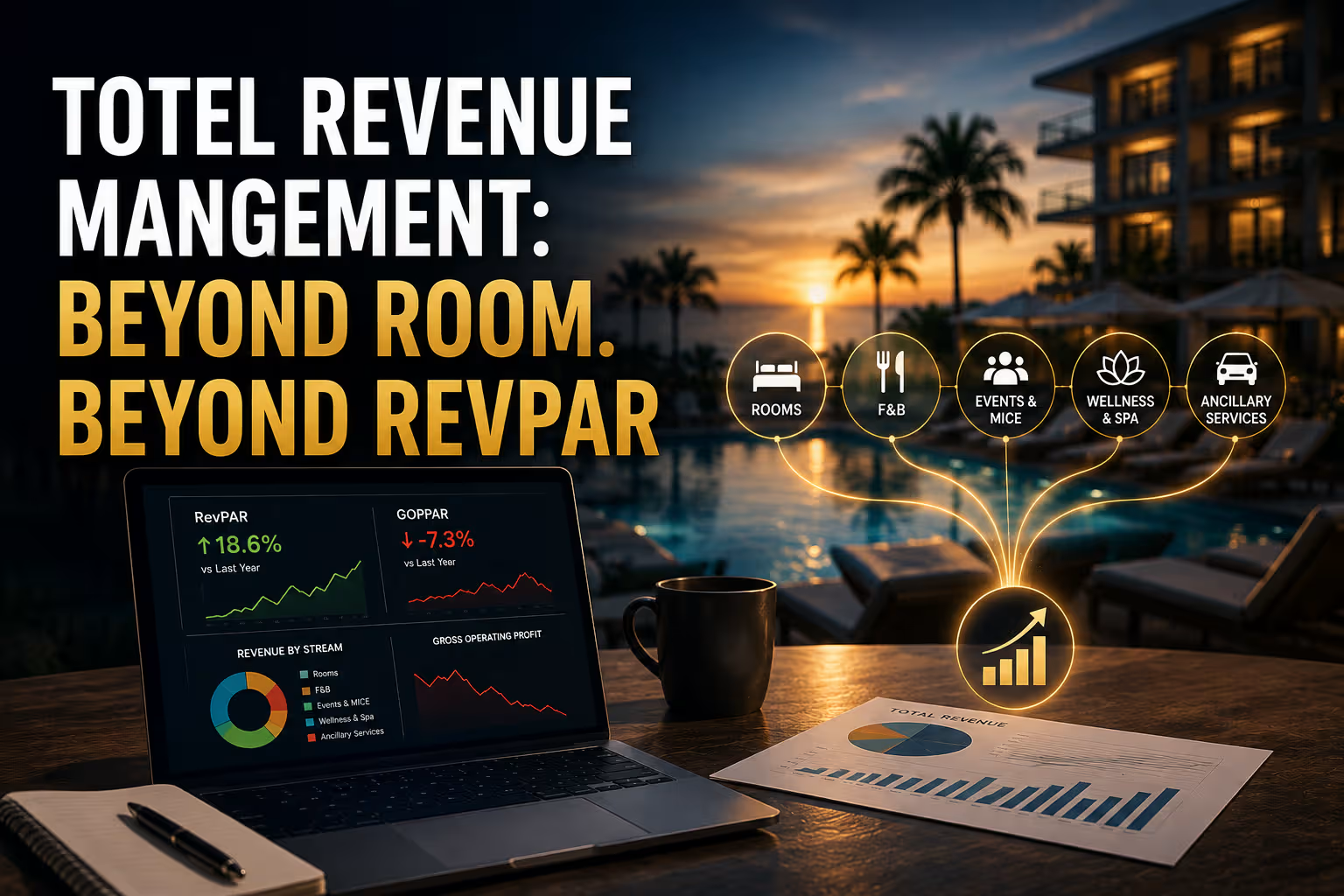


Key Takeaway: Most hotel revenue management failures are not caused by bad math or missing data. They happen because the correct decision creates an immediate emotional cost for the operator, while the wrong decision hides its damage for weeks inside a spreadsheet nobody reads until month end.
Ask any experienced revenue manager whether they know the right thing to do on a given night, and most of them will say yes without hesitation. Raise the rate here. Close the discounted OTA channel there. Decline the group block that pays 40 percent below rack. They know. They have known for years.
And yet, on the actual night in question, they often do the opposite. The rate stays low. The OTA promotion stays on. The group block gets accepted.
This is the real story of hotel revenue management. It is rarely a knowledge problem. It is a behavior problem wearing a spreadsheet as a disguise. The rest of this article walks through where the standard playbook breaks down, why capable people keep breaking it the same way, and what an independent property can actually do differently, including realities that are specific to running a hotel in India.
The BAR Ladder Feels Safe, Which Is Exactly the Problem
Most independent properties still price using a Best Available Rate ladder. One master rate moves, and every other rate, corporate, OTA, package, and promotional, shifts with it as a fixed percentage. It is simple to build, simple to explain to an owner, and simple to defend in a monthly review.
It is also mathematically wrong.
A corporate traveler booking a Tuesday night on a negotiated rate does not behave like a leisure guest booking a weekend getaway through an OTA. Their price sensitivity is different. Their booking window is different. Their cancellation behavior is different. When a BAR ladder forces both segments to move in lockstep, one of two things happens on any given date: the hotel underprices the corporate guest who would have paid more, or it prices out the leisure guest during a shoulder period when that guest was the only demand available.
The alternative, known in the industry as Open Pricing, treats each segment, channel, and room type as its own demand curve. A property using Open Pricing can close a heavily discounted OTA channel while leaving direct and corporate rates untouched, without breaching rate parity, because parity only governs the public rate, not every internal segment.
Why do so many properties still run a BAR ladder despite knowing this? Because it is anchored. It is what the owner understands, what the front desk understands, and what last year's spreadsheet used. Letting go of a single master rate feels like losing control, even when the control was never mathematically sound to begin with. There is a real constraint too: many corporate RFP contracts carry Last Room Availability clauses and fixed-discount terms that legally lock a segment to the BAR ladder. Open Pricing is the better model, but only where the contract allows it, so this is a negotiation point for next year's corporate agreements, not a switch you flip today.
The Metric on the Dashboard Is Lying to You, Politely
For three decades, RevPAR has been the number that gets reported to owners, benchmarked against the competitive set, and tied to bonus structures. It is also a number that can rise while the property quietly loses money.
RevPAR only measures revenue per available room. It says nothing about what it cost to acquire that booking. A property can post a record RevPAR by leaning hard on 25 percent commission OTA channels and heavy digital ad spend, and still watch gross operating profit fall in the same month. RevPAR correlates with underlying asset value at roughly 70 to 75 percent. GOPPAR, which accounts for operating costs, correlates at 85 to 90 percent. NetRevPAR, which nets out acquisition cost, tells a similar story at the top-line level.
The reason RevPAR survives is not analytical, it is organizational. It is the number everyone already tracks, the number STR reports use, the number that is easiest to defend in a boardroom because gross revenue is far easier to manipulate upward than net profit. A revenue manager under pressure to hit an occupancy target has a fast lever: discount on OTAs, watch RevPAR climb, and let the commission bill land somewhere the owner is less likely to scrutinize closely.
If your monthly review only shows RevPAR and occupancy, you are measuring activity, not health. Add NetRevPAR and GOPPAR to the same report, even informally, and the incentive to chase volume through discounting starts to lose its cover.
The same logic extends to food and beverage. Cornell's RevPASH concept treats a restaurant seat for an hour as perishable inventory, the same way a room night is perishable. Gross covers and average check size can both rise while table turn times quietly destroy profitability. If your property runs banquets, events, or a full-service restaurant, tracking RevPASH alongside room metrics closes a blind spot that gross revenue figures conveniently hide.
Why a Confirmed Group Contract Feels Safer Than It Is
Group business creates a specific kind of comfort. It is confirmed, it is on the books months in advance, and it removes the anxiety of an empty calendar. That comfort is exactly why so many properties accept group blocks at rates that quietly destroy yield.
The correct way to evaluate a group is to net out margin, not compare gross figures. Room revenue typically flows to gross operating profit at around 70 percent margin. Food and beverage or banquet revenue, once you account for labor and food cost, usually lands closer to 30 percent margin.
| Revenue Source | Typical Margin | What It Means for Displacement |
|---|---|---|
| Transient room revenue (direct/OTA) | ~70% | High yield once OTA commission of 15-25% is netted out |
| Group room revenue | ~70% | High yield, but often carries heavy rate discounting |
| F&B and banquet revenue | ~30% | Gross figures overstate real contribution significantly |
| Ancillary (spa, parking) | 40-60% | Depends heavily on fixed facility costs |
A group that looks impressive on gross revenue can be a poor trade once you weight the F&B portion at its real margin and compare it against the transient room revenue it would displace during a compression period. The failure is not that revenue managers do not know this math. It is that a confirmed group booked twelve months out feels like a bird in hand, while the transient demand it might displace is only a forecast. Forecasts are easy to discount emotionally. Signed contracts are not.
The fix is procedural, not motivational: run every group request through a displacement calculation that applies the 70 percent and 30 percent multipliers before it reaches an accept or decline decision, especially for any dates that already show strong booking pace.
The Overbooking Buffer Nobody Wants to Own
Overbooking is one of the few areas in revenue management where the math is genuinely settled. An optimal buffer balances the cost of an empty room against the cost of walking a guest, and the tipping point can be calculated with reasonable precision using historical no-show and cancellation data.
The problem is not the calculation. The problem is that the two costs feel completely different to a human being standing in the lobby. An empty room from an unfilled cancellation is silent. Nobody sees it, nobody complains about it, and the accounting team notices it, if at all, weeks later in a spoilage report. A walked guest is loud, immediate, and often furious in person. That asymmetry pushes general managers to override the algorithm and zero out the overbooking buffer, trading a large, invisible, recurring loss for protection against a small, visible, occasional one.
There is a legitimate limit to the model too. An experienced GM is right to push back on any overbooking algorithm that treats every walked guest identically. Walking a loyalty member or a corporate account that books hundreds of room nights a year carries a relationship cost that a flat compensation figure does not capture. The answer is not to abandon the buffer, it is to build a tiered exception: apply the algorithmic buffer as the default, and carve out a short list of protected accounts that are never eligible to be walked regardless of what the math suggests.
The GST Trap That Generic Pricing Tools Can Miss
This is the part of revenue management where generic dynamic pricing models can fall short for Indian properties, not because of a modeling flaw, but because the tax code itself is not smooth.
From September 2025, hotel accommodation valued at up to ₹7,500 per unit per day attracts 5 percent GST without input tax credit, while accommodation priced above ₹7,500 attracts 18 percent GST, but with input tax credit available. Because the higher rate applies to the entire tariff once the threshold is crossed, the pricing discontinuity right at ₹7,500 is sharp.
| Public Rate (₹, GST-inclusive) | GST Rate | Net Revenue Before GST (₹) | What Happened |
|---|---|---|---|
| 7,499 | 5% (no ITC) | 7,141.90 | Just under the threshold |
| 7,500 | 5% (no ITC) | 7,142.86 | Threshold rate, still at 5% |
| 7,501 | 18% (with ITC) | 6,356.78 | One rupee higher, ₹786 less retained |
| 7,800 | 18% (with ITC) | 6,610.17 | Still well below the ₹7,500 outcome |
| 7,950 | 18% (with ITC) | 6,737.29 | Still short of the true break-even |
| 8,428.57 | 18% (with ITC) | 7,142.86 | Break-even point versus ₹7,500 at 5% |
Crossing the threshold by a single rupee, from ₹7,500 to ₹7,501, drops the GST-exclusive amount retained by roughly ₹786 if the rate is quoted GST-inclusive and nothing else changes. To recover the same GST-exclusive revenue that ₹7,500 produces at 5 percent, a property would need to price at approximately ₹8,429 once the 18 percent bracket applies.
The insight for revenue management is not simply to avoid a fixed band of rates. It is to make sure the RMS or pricing workflow explicitly models this threshold and asks whether crossing ₹7,500 creates enough additional economic value to justify the higher tax rate, factoring in that the 18 percent bracket comes with input tax credit while the 5 percent bracket does not. That ITC value depends on the property's own cost structure, so the two options are not directly comparable on GST-exclusive revenue alone. A property should compare the after-tax, after-ITC economics of holding the rate at ₹7,500 against moving decisively above it, rather than assuming every rupee above the threshold is lost.
This is exactly the kind of India-specific tax rule that a generic pricing model can overlook if its optimization objective only considers demand, occupancy, ADR, and competitor pricing. For Indian properties, the GST threshold needs to be built into the pricing rules and rate architecture directly, not left to a system that assumes a smooth demand curve.
The OTA Relationship Is Not a Partnership, It Is Leverage
The Indian online travel landscape is unusually concentrated. MakeMyTrip and Goibibo, under common ownership, account for an estimated 50 to 60 percent of domestic online hotel bookings. Public commission caps sit near 22 percent, but once auto-enrolled promotions, visibility boosters, and mobile-only discount programs are added in, the effective acquisition cost often climbs closer to 30 to 35 percent.
OTA market managers are trained to frame participation in these programs as a condition for search ranking, not a choice. Revenue managers, understandably anxious about losing visibility, tend to comply, and the anxiety is louder than the numbers. The NetRevPAR math that would show a 25 percent commission on a discounted rate is worse than leaving a room unsold on a genuinely low-demand date sits in a report that gets reviewed monthly. The dashboard warning about a ranking drop shows up today.
A useful discipline here is a quarterly audit: every OTA promotion, mobile discount, and wholesale program gets measured against the property's cost per occupied room. Any program that pushes net yield below that threshold gets switched off, regardless of what it does to search ranking. This removes the decision from the moment of anxiety and turns it into a scheduled review, which is where most people actually make better calls.
WhatsApp Is the Direct Channel Indian Properties Already Own
The counter to OTA dependence in India is not a bigger marketing budget. It is a channel most guests already have open on their phone. WhatsApp carries a roughly 95 percent open rate, and for independent resorts and leisure properties, it has become the most reliable direct booking engine available.
Routing post-checkout messages, instant booking confirmations, and pre-arrival concierge communication through the WhatsApp Business API, using cost-efficient providers, captures a guest's opted-in number and intent data legally and permanently. When that guest is ready to book again, a targeted message costing roughly ₹0.86 to send can generate a booking that would otherwise have cost the property ₹750 or more in OTA commission.
The reason this remains underused is not cost. It is that teams see the WhatsApp Business API as an IT project rather than a marketing lever they can start using this month. Most properties can get a basic version running with confirmation messages and post-stay follow-ups without a large technical build, and the return shows up directly in repeat booking commission savings, which is one of the few revenue management interventions with a fast, visible payback.
What Agentic AI Actually Does to Independent Properties
The expectation going into 2026 was that AI travel assistants would finally let independent hotels bypass OTAs and capture direct bookings at scale. What has actually happened is closer to the opposite. Agentic AI systems and emerging integration frameworks are connecting natively to the API infrastructure of Booking.com and Expedia, which means AI-generated search queries are being routed through the very channels these tools were expected to disrupt. Independent properties, without the technical infrastructure to interface directly with these AI models, are becoming more dependent on OTAs for AI-driven visibility, not less.
There is a real opportunity inside this shift, in Attribute-Based Pricing. Rather than selling static categories like Standard, Deluxe, and Suite, properties can unbundle inventory into specific attributes such as a high floor, a balcony, or a view, and price each one as a premium modifier. Guests demonstrably pay for specific attributes even when the base room category rate stays untouched, which means incremental revenue without a visible increase to the headline rate.
One caution worth flagging honestly: as more properties in a competitive set adopt the same rate-shopping and AI pricing tools, algorithms can start tacitly mirroring each other's pricing without any human coordination. Regulators in multiple markets, including India's Competition Commission, are actively scrutinizing this kind of algorithmic price coordination. The practical guardrail is straightforward: do not configure your pricing tool to automatically match or undercut a specific competitor. That is exactly the pattern that creates a predictable, exploitable, and increasingly scrutinized pricing loop.
Why Airline-Style Yield Management Does Not Translate Cleanly
Hotel revenue management borrows heavily from airline yield algorithms built in the 1980s, and the borrowing has limits. Airlines control tightly standardized inventory, a coach seat is a coach seat, and they push price changes instantly across a single controlled network. A hotel's price update has to travel through a PMS, a central reservation system, a channel manager, and finally the OTA extranet before a guest ever sees it. Every hop in that chain is a place for latency, sync errors, and rate parity violations to creep in.
This is worth knowing not as trivia but as a diagnostic. If your property is seeing rate discrepancies across channels or unexplained overbooking incidents, the root cause is frequently not a pricing decision at all. It is a synchronization gap somewhere in that technology stack, and it is worth auditing the update latency across your channel manager before assuming the pricing strategy itself is wrong.
What This Actually Means for How You Run Revenue Management
Every section above points to the same underlying pattern: the math in hotel revenue management is largely solved. Open Pricing, GOPPAR, displacement multipliers, overbooking buffers, GST-aware pricing rules, none of this requires new research to implement. What breaks it is the gap between what the numbers say and what feels safe to do in the moment.
A few starting points worth prioritizing over the next quarter:
- Add NetRevPAR and GOPPAR to your monthly ownership report alongside RevPAR, so occupancy gains cannot be reported without their acquisition cost attached.
- Run a displacement calculation, using the 70 percent room and 30 percent F&B margin split, on every group request above a defined room-night threshold before it is approved.
- Audit every OTA promotion and discount program quarterly against your cost per occupied room, and shut off anything that fails the threshold regardless of ranking impact.
- Build the ₹7,500 GST threshold into your pricing workflow so any rate crossing it is a deliberate, after-tax, after-ITC decision, not an automated recommendation nobody reviewed.
- Set up WhatsApp Business API messaging for booking confirmations and post-stay follow-ups this month, not as a future project.
- Keep your overbooking buffer algorithmic by default, with a short, explicit list of protected accounts exempted, rather than zeroing the buffer out entirely after one bad experience.
None of these require new software. Most of them require a process that removes the decision from the moment it feels emotionally difficult and moves it into a scheduled review where the numbers get the final word.
The Real Discipline Behind Revenue Management
The uncomfortable truth about hotel revenue management is that the properties losing the most margin are rarely the ones without data. They are the ones with data sitting next to decisions that ignore it, because the person making the call is responding to what is visible and immediate rather than what is correct and delayed. A confirmed group feels safer than a forecast. A ranking warning feels more urgent than a commission line item. An empty room feels less painful than a guest shouting in the lobby.
Revenue management, done properly, is less about finding a smarter algorithm and more about building processes that protect good decisions from the moments they are hardest to make.
Ready to build a revenue management strategy that actually holds up under Indian market conditions, not just textbook assumptions? Grow Engine works with independent properties across India and globally to implement revenue management and commercial systems that fit your market, your guests, and your goals. Get in touch today through https://www.growengine.in/contact.