

Key Takeaway: A public discount solves tonight's occupancy problem and creates next month's pricing problem. Hotel fenced rates solve both at once by targeting price-sensitive segments privately while leaving the public rate, and your brand's perceived value, completely intact.
The Munnar Weekend That Looked Fine Until the Numbers Came In
It is Thursday afternoon in Munnar. A boutique plantation property is sitting at 45 percent occupancy for Saturday. The revenue manager does what feels rational: drops the public Best Available Rate by 25 percent across every connected OTA.
Six reservations arrive within three hours. The team calls it a success.
The Sunday analysis tells a different story. Two of those bookings were existing guests who cancelled and rebooked at the cheaper rate. An OTA compliance bot flagged a parity violation. The property's search ranking was quietly suppressed. By weekend close, occupancy was acceptable but the contribution margin had collapsed: ADR dilution, commission on rebookings, and an algorithmic penalty had turned a demand problem into a profit problem.
This plays out continuously across Indian independent hotels. The root cause is not weak demand. It is the default response to weak demand: a public, unconditional price cut that trains guests to wait, triggers OTA penalties, and permanently erodes the reference price that underpins brand value.
The alternative is hotel fenced rates: deep discounts delivered exclusively to specific segments without ever touching the public rate. Juyo Analytics confirms that unmanaged rate leakage and ADR dilution consume 4 to 9 percent of total annual room revenue. Rate fencing eliminates this leakage through structured discount controls, producing higher ADR and stronger conversion simultaneously.
Why Public Discounts Cost You More Than They Earn
The margin mathematics are brutal. A room at ₹5,000 with ₹1,000 variable costs and 20 percent OTA commission (₹1,000) produces a ₹3,000 contribution margin. Drop the rate 20 percent to ₹4,000: commission falls to ₹800, variable costs hold at ₹1,000, and the new margin is ₹2,200. A 20 percent price cut produced a 26.6 percent profit collapse. The operator sees occupancy. The P&L sees the damage.
Every buyer claims a public discount, including those who would have paid full rate. A corporate traveler notices the lower public rate, cancels the flexible booking, and rebooks cheaper. Revenue cannibalization is guaranteed when the discount has no qualifying restriction attached.
OTA algorithms punish parity gaps regardless of legality. The 2022 CCI ruling against MMT-Go and OYO penalized wide parity clauses, giving Indian hotels legal freedom to price direct channels below OTAs. But the algorithmic reality is unchanged: OTA sorting systems still suppress properties whose rates fall out of alignment across channels. A sync delay between two platforms is enough to trigger a ranking penalty that outlasts the discount by weeks.
Brand reference price erosion is the slowest and most expensive consequence. Cornell research by Kimes and Wirtz established the dual entitlement principle: guests believe they deserve a fair price and the seller deserves a fair profit. Repeat public discounting teaches the market to wait for the next price collapse. That lesson costs the property its pricing power on high-demand dates, often only becoming visible 12 to 18 months later when rack rates no longer hold.
Hidden discounts (rate-fenced offers invisible to the public market) are the mechanism that breaks this cycle without losing the demand.
Three Rate Fences to Build This Week
| Fence Type | Mechanism | Discount Range | Who Sees It |
|---|---|---|---|
| Transactional | Non-refundable, no-modification condition | 10–15% | Leisure guests who can commit; filters out flexibility-needing corporate |
| Non-physical (CUG) | Password-protected, email-only, not web-scrapable | 20–25% below BAR | Past guest database via private email link |
| Physical (Bundle) | Package above BAR with low-cost value add | Room + F&B credit, priced above BAR | All channels; communicates value without rate dilution |
Transactional fences: sell flexibility as the premium. Offer a 10 to 15 percent discount attached to a strict non-refundable, no-modification condition. A corporate traveler needing schedule flexibility will not accept this restriction, so they self-select into the full flexible rate. A leisure guest planning four weeks ahead happily commits for the saving. The fence filters by segment automatically, with no manual intervention required. The critical rule: enforce it absolutely. A waived cancellation penalty trains the market that the restriction is negotiable. The fence collapses within weeks.
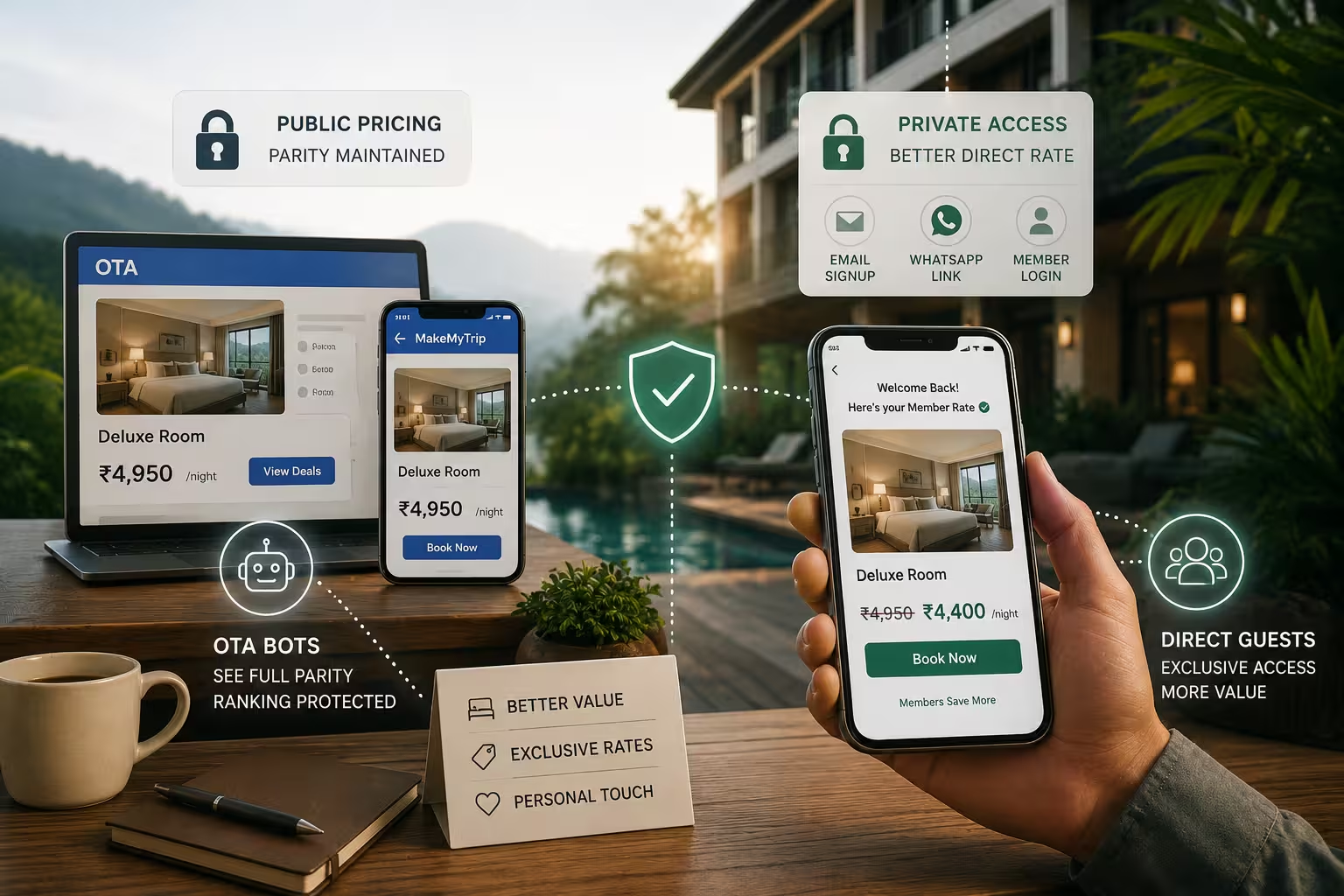
Non-physical fences: authenticate who sees the discount. A Closed User Group (CUG) rate sits behind an authentication wall: a login, a member portal, or a private email link. Critically, it cannot be scraped by OTA compliance bots because it is not publicly accessible. The property can offer 20 to 25 percent below the public BAR to its direct email database without triggering a single parity violation. Triptease data confirms that maintaining strict public parity while deploying private CUG discounts increases direct booking conversion by up to 34 percent. This is the rate fencing example every Indian independent hotel should be running as a permanent direct booking strategy, not as a slow-season emergency measure.
Physical fences: bundle value instead of cutting price. Rather than dropping the room from ₹5,000 to ₹3,750, create a package at ₹5,600 that bundles the room with ₹1,200 in F&B credit. The credit costs approximately ₹600 in variable cost. The package generates more revenue per booking than the room-only rate, the public BAR remains untouched, OTA parity is maintained, and the guest perceives exceptional value rather than a desperate discount. Opaque packaging is how a property communicates softness in demand without ever signaling it.
One Property, One Monsoon Season, Real Results
A 34-room boutique resort in Coorg had trained its repeat guest base to wait for the annual monsoon rate cut. The revenue manager replaced the habit with a three-step fencing deployment over one week.
| Step | Method | Terms | Result |
|---|---|---|---|
| 1 | Private CUG email (680 guests) | 22% off, password-protected, min 2-night | 11 bookings in 72 hrs; 0 parity violations |
| 2 | Advance purchase non-refundable rate | 14% off, 28-day window, hard cancellation | 8 bookings; all leisure guests; 0 corporate |
| 3 | Monsoon Escape package on 2 OTAs | Room + breakfast + walk @ ₹5,800 (above ₹5,200 BAR) | ADR went up, not down |
The combined outcome: blended ADR rose 12.4 percent versus the prior-year period. Direct booking share moved from 24 to 41 percent. OTA commission costs fell by ₹2.1 lakh for the season. Zero parity violations were flagged.
The Bottom Line: Discount Precisely, Not Publicly
Hotel fenced rates require no enterprise software. They require three decisions: which guests qualify, what condition they must accept, and which channel delivers the offer privately. Any property with a booking engine and a guest email list can build this architecture this week.
Take two actions now:
-
Send one CUG rate to your past guest database this week. Set a rate 15 to 20 percent below BAR on a password-protected booking page. Send a private email. Publish nothing publicly. Track bookings in 72 hours and confirm zero parity violations.
-
Activate one non-refundable advance purchase rate on your direct booking engine for your next high-demand date. Set it 12 to 15 percent below the flexible rate with an explicit 28-day window and hard cancellation terms. Track which segment books it. If it is exclusively leisure guests, the fence is working.
The market rewards precision, not volume. Build the fence, hold the public rate, and let the architecture do the work.
Ready to build a hotel fenced rates and rate fencing strategy tailored to your property? Grow Engine works with hotels across India and globally to implement revenue management systems that fit your market, your guests, and your goals. Get in touch with us today.