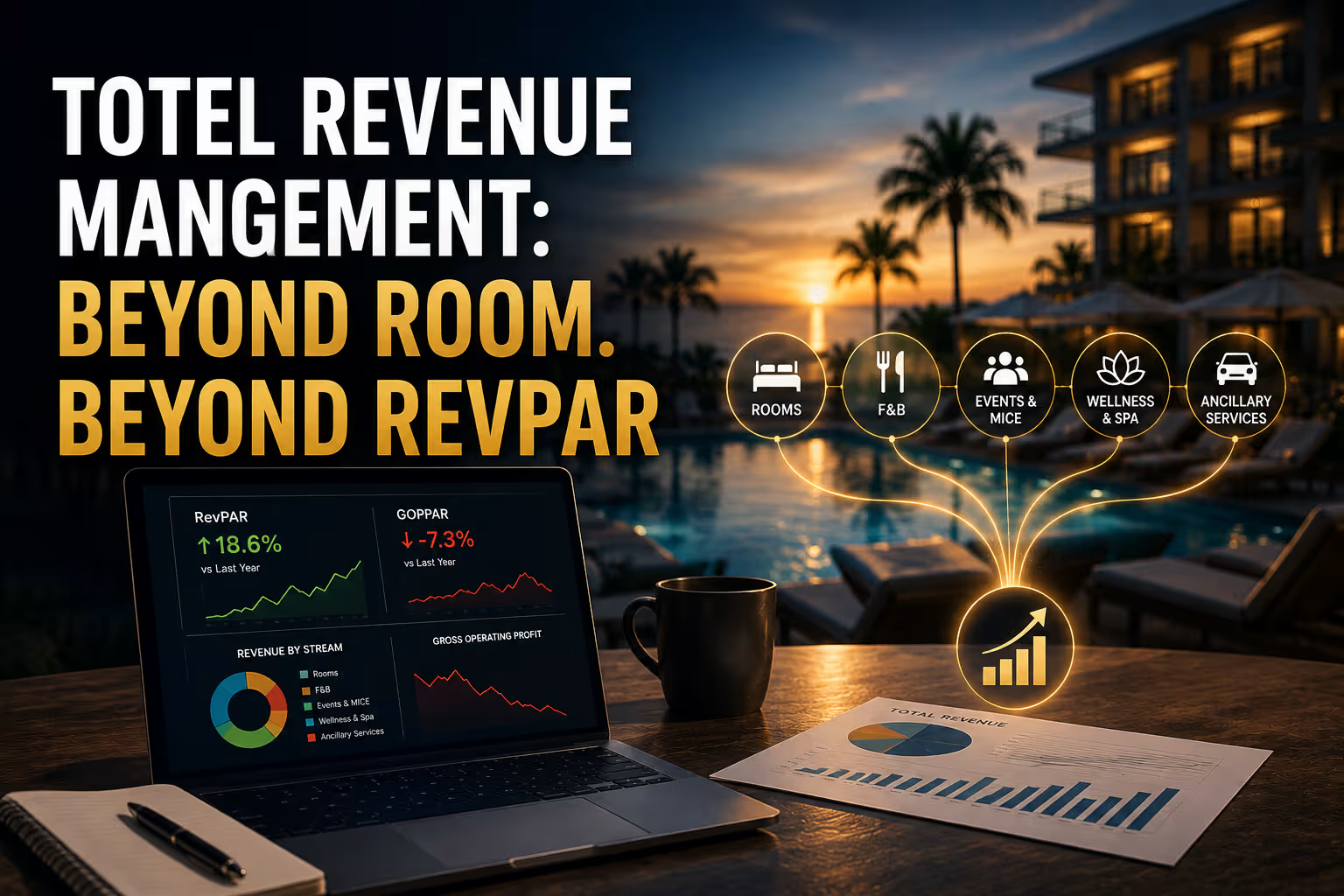


Key Takeaway: Hotels that replace fixed seasonal rates with demand-driven dynamic pricing consistently capture 15–30% more revenue not by discounting less, but by charging the right price at the right moment.
The Night That Changed Everything
Picture this: it's a Thursday evening in March. Your 40-room property sits at 55% occupancy. You've priced rooms at ₹4,500 for the weekend the same rate you've used every March for the past four years. Reasonable, you think. Predictable. Safe.
Two kilometres away, a competitor just listed their last five rooms at ₹7,200. They sold out by 9 PM.
On Saturday morning, you check your OTA dashboard. You sold 31 rooms at ₹4,500. They sold 40 rooms at an average of ₹6,800. Same weekend. Same city. Vastly different outcomes.
The difference wasn't location, star rating, or even reviews. It was pricing strategy specifically, the decision to move beyond fixed seasonal rates toward hotel dynamic pricing.
This is the central challenge facing independent hoteliers today: not low demand, but underpriced demand. Yield management and data-driven hotel revenue strategies exist precisely to close this gap. This guide explains how they work, why fixed rates are costing you money right now, and what you can do about it starting this week.
Why Fixed Seasonal Rates Are Quietly Draining Your Revenue
Most independent hotels in India still operate on a version of the same pricing model: a peak rate, an off-peak rate, and perhaps a "shoulder season" rate somewhere in the middle. These tiers are set once or twice a year, often based on gut feel, historical occupancy, or what the property down the road is charging.
On the surface, this feels logical. Predictable pricing means easy communication with guests, simple front desk operations, and less time spent thinking about numbers.
But here is the problem: demand does not move in three speeds. It moves hourly.
A cricket final announced on Monday will compress hotel inventory across an entire city by Friday. A conference that books out all five-star properties will push leisure guests into mid-market hotels they'd never otherwise consider. A long weekend creates a 72-hour window where price-inelastic travellers guests who have already made the emotional decision to travel will pay considerably more than your fixed rate assumes.
Fixed pricing cannot respond to any of this. While your rate sits at ₹4,500, market demand may be signalling ₹7,000. The revenue difference on a 40-room property over a single compressed weekend can exceed ₹1,00,000. Multiply that across a year of missed signals, and the cost of inaction becomes structural.
The data reinforces this reality. According to HotStats 2025, global RevPAR (Revenue Per Available Room) grew 19% since 2019 but distribution costs grew 25% in the same period. Margins are under pressure from every direction. In that environment, leaving pricing on autopilot is not a neutral decision. It is an active loss.
The Four Building Blocks of Hotel Dynamic Pricing
Hotel dynamic pricing is not a single tactic. It is a system of interconnected decisions made in response to live market signals. Here is how it breaks down into four practical components every independent hotel can implement:
| Building Block | What It Does | Implementation |
|---|---|---|
| Occupancy-triggered rate ladders | Rate steps up as inventory fills (60%, 80%, 90%) | Spreadsheet + daily review |
| Demand-signal monitoring | Watch competitor rates, events, booking pace, OTA availability | Rate-shopping tool + local event calendar |
| Length-of-stay (LOS) controls | MinLOS blocks 1-night stays on peak dates | Set via OTA extranets + channel manager |
| Fenced, segmented rates | Non-refundable, member-only, long-stay offers | Create separate rate plans in channel manager |
-
Occupancy-triggered rate ladders. Set predetermined price thresholds tied to your real-time occupancy. A common framework: once you cross 60% occupancy for a given date, rates step up by 10–15%. At 80%, they step up again. At 90%, you activate your highest rack rate and consider closing discount channels entirely. This is the core logic of yield management selling the right room to the right guest at the right price at the right time. It requires no sophisticated software to begin; a simple spreadsheet and a disciplined daily review is enough to start capturing value.
-
Demand-signal monitoring. Price intelligently by watching the signals your market is constantly sending. These include: competitor rate changes (check manually or via a rate-shopping tool), local event calendars (concerts, festivals, government conferences, IPL matches, holiday weekends), booking pace for specific dates (are you filling faster or slower than usual?), and OTA availability when competitors reduce availability on a given date, demand compression is already underway. The goal is to act before the demand peak, not after it.
-
Length-of-stay (LOS) controls. During high-demand periods, a single-night booking on a Saturday can block a guest willing to book Friday–Sunday. Setting a minimum LOS of two or three nights during peak dates protects your revenue by ensuring you capture full-stay value rather than filling gaps with one-night arrivals that leave unrentable shoulder nights on either side. Conversely, on slower mid-week dates, removing LOS restrictions and activating tactical discounts for two-night stays can lift occupancy without broadly reducing your rates.
-
Fenced, segmented rates instead of blanket discounts. When demand softens, the instinct is to drop your rack rate publicly. Resist it. Instead, create fenced offers: a non-refundable advance purchase rate (available only 21+ days out), a member-only rate through your direct booking channel, or a long-stay rate for guests booking four or more nights. These offers reach price-sensitive guests without signalling to the broader market or to your regular corporate accounts that your rates have softened. This is how large hotel chains protect ADR (Average Daily Rate) during shoulder periods while still generating occupancy.
A Real-World Week: Putting Dynamic Pricing Into Practice
| Day | Signal | Action Taken | Result |
|---|---|---|---|
| Tuesday eve | Alumni convention (800 attendees) + 2 hotels near sellout | Rate: ₹5,200→₹6,800; Min 2-night stay | 7 bookings arrive Wed |
| Wednesday | 65% occupancy, pace accelerating | Rate: ₹7,500 Sat, ₹6,200 Fri; direct ₹300 bonus | Continued two-night bookings |
| Thursday | 82% occupancy | Rate: ₹8,200; close non-refundable rate; direct-only for Sat | Rate elevated 58% vs start |
| Saturday | Weekend closes | 94% occupancy; avg ₹7,100 vs ₹5,200 fixed | +₹1,14,000 revenue for weekend |
Consider a 35-room independent hotel in Pune. It's the Tuesday before a long weekend. Current occupancy for Friday–Sunday sits at 40%. The hotel's fixed rate: ₹5,200.
Tuesday evening: The revenue manager checks a local events calendar and notices a national alumni convention is booked at a nearby venue 800 attendees, arriving Friday. She also checks two competitor hotels on Booking.com; both have reduced their available inventory to under five rooms for Saturday night. She raises the hotel's Saturday rate immediately from ₹5,200 to ₹6,800, and sets a minimum two-night stay for Friday–Saturday bookings.
Wednesday: Seven bookings arrive for the weekend, almost all for two nights. Occupancy for Saturday crosses 65%. She triggers the next rate tier: ₹7,500 for Saturday, ₹6,200 for Friday. The OTA listing is updated. The direct booking channel is updated to match, with an additional ₹300 discount for guests who book directly.
Thursday afternoon: Saturday hits 82% occupancy. She raises the Saturday rate to ₹8,200, closes the non-refundable advance purchase rate (no longer needed to pull demand forward), and removes OTA inventory allocation for Saturday directing remaining rooms to the direct channel only, saving the 18% commission.
Saturday night: The hotel closes at 94% occupancy for the weekend. Average rate achieved: ₹7,100 across Friday and Saturday combined, versus the ₹5,200 fixed rate she started with. On a 35-room property, that difference ₹1,900 per room per night across roughly 60 room-nights represents an additional ₹1,14,000 in revenue for a single weekend.
No new marketing spend. No renovations. Just better pricing decisions made in response to signals that were already there.
The Bottom Line: Price Is Not a Fixed Fact It Is a Daily Decision
Fixed seasonal rates were designed for a world where demand moved slowly and information was scarce. That world no longer exists. Today, demand signals arrive in real time, competitors adjust rates daily, and guests make booking decisions across dozens of platforms simultaneously.
Hotel dynamic pricing does not require a large revenue management system or a full-time analyst to begin. It requires a commitment to treating price as a living variable one that reflects what the market is willing to pay today, not what it paid last March.
Start with the following two actions this week:
-
Audit your next 30 days of inventory. Identify any dates where you have known demand drivers (local events, holidays, nearby conferences) and check whether your current rates are set above or below your competitors for those specific dates. Adjust accordingly even a manual rate change on three or four high-demand nights will immediately demonstrate the revenue impact.
-
Create a simple occupancy-based rate ladder. Define what your rate will be at 50% occupancy, 70%, and 85% for your standard room type. Write it down. Review your occupancy for in-date arrivals every morning and move rates to the corresponding tier. This single habit ten minutes per day is the foundation of yield management, and it costs nothing to start.
The hotels winning on revenue in 2026 are not necessarily the biggest or the best-branded. They are the ones making smarter pricing decisions, more often, with better information. That is a competitive advantage every independent hotel can build.
Ready to build a hotel dynamic pricing and yield management strategy tailored to your property? Grow Engine works with hotels across India and globally to implement revenue management systems that fit your market, your guests, and your goals. Get in touch with us today.