

Key Takeaway: You do not need to replace 100 OTA bookings with 100 direct bookings. Because direct channels cancel less and yield more, 79 direct room nights replace the exact same bottom-line cash flow.
Occupancy That Never Reaches the Bank Account
A familiar situation plays out in hotel back offices every week. The property looks highly occupied on paper. The revenue manager sees strong booking volume for an upcoming long weekend. But when the finance team audits the net cash flow deposited into the operating account, the numbers do not match the occupancy levels.
The revenue was technically generated, but it was severely diluted before it ever reached the property.
The standard industry belief is that independent properties pay roughly 18 percent commission to major platforms like Booking.com. This figure is treated as a fixed cost of doing business. However, when you look beneath the surface of the merchant model, visibility programs, and cancellation displacement, the actual cost of acquiring that guest is often far higher.
The problem is not the commission rate itself. The problem is a distribution strategy that hands pricing control, guest data, and payment processing entirely to a third-party algorithm.
The Invisible Margin Tax
The visible commission rate negotiated with an Online Travel Agency fundamentally misrepresents the true cost of customer acquisition.
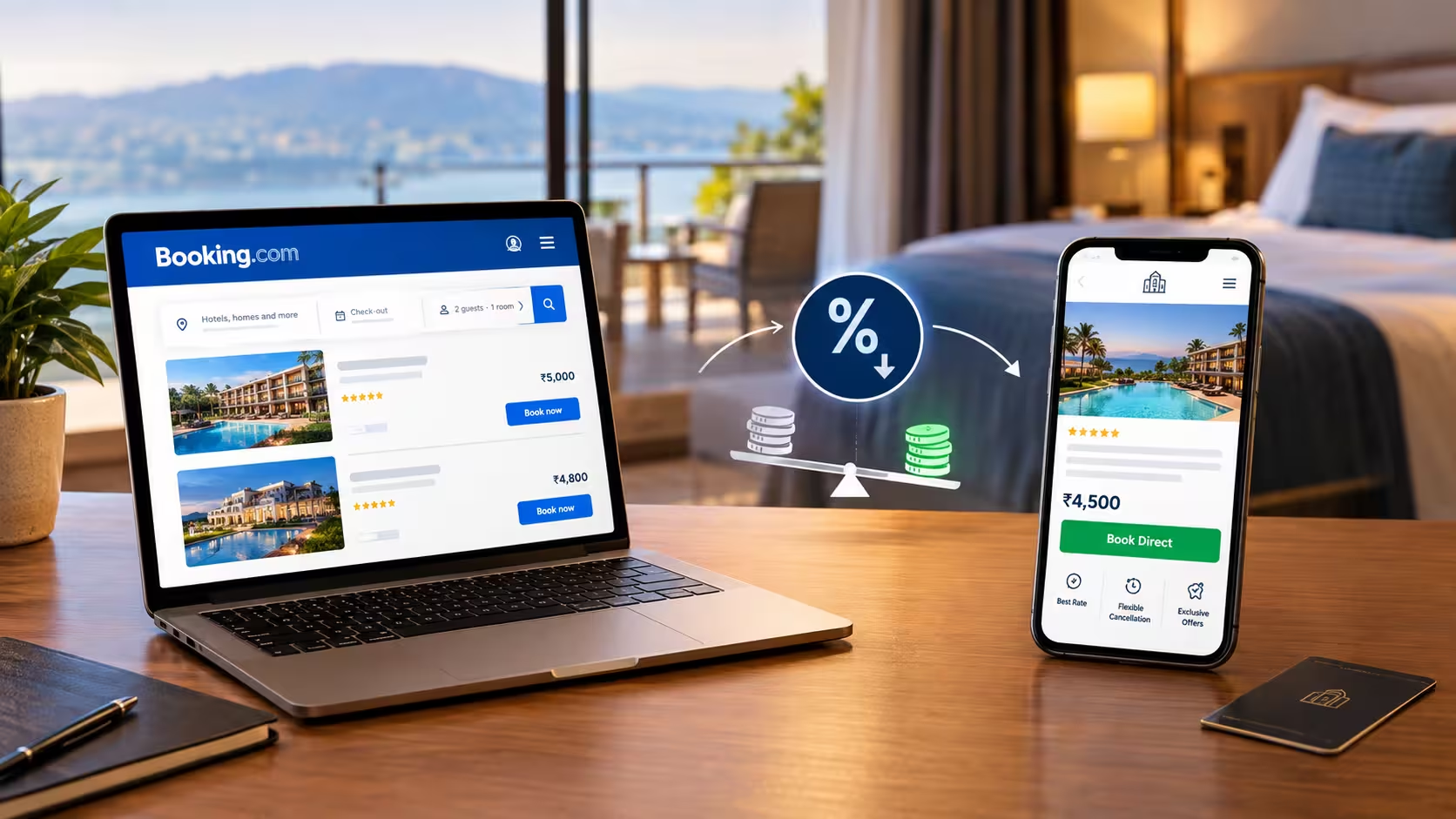
When a property participates in the Booking.com Genius program, the 10 to 20 percent consumer discount is funded entirely from the property's gross margin. The platform does not reduce its commission. The hotel simply realizes a lower rate.
Furthermore, properties enrolled in "Payments by Booking.com" transition from an agency model to a merchant model. The OTA issues a Virtual Credit Card (VCC) to pay the hotel, which introduces an additional payment processing interchange fee that averages 3 percent.
Why do experienced general managers accept this? The answer is cognitive ease. VCCs eliminate the operational friction of chasing declined guest credit cards for no-shows or managing cross-border transactions. The human element of hotel operations often compartmentalizes these expenses. The GM sees a "financial processing cost," while the revenue manager sees a "marketing cost."
When combined, a standard 18 percent base commission, a 10 percent Genius discount, and a 3 percent VCC fee compound into a True Commission Rate (TCR) approaching 28.9 percent.
The financial difference between channels becomes obvious when mapping the unit economics of a standard room night.
| Metric | OTA Channel (Standard) | OTA Channel (Genius + VCC) | Direct Website Channel |
|---|---|---|---|
| Gross Booked Rate | ₹5,000 | ₹4,500 (10% funded discount) | ₹5,000 |
| Commission / Acquisition | 18% (₹900) | 18% (₹810) | 6% Ads + 2% Engine (₹400) |
| Payment Gateway / VCC Fee | 0% (collect at hotel) | 3% VCC fee (₹135) | 2% Gateway MDR (₹100) |
| Net ADR Realized | ₹4,100 | ₹3,555 | ₹4,500 |
| Total Margin Leakage | 18.0% | 28.9% | 10.0% |
Margin Impact: A standard OTA room night delivers ₹4,100 to the property. The same night sold direct delivers ₹4,500. For a 50-room property operating at 65 percent occupancy, shifting just 3 percent of total room nights from the highly taxed Genius plus VCC OTA model to a direct channel adds over ₹3.3 lakh straight to the Gross Operating Profit line annually, without requiring a single additional guest arrival.
The Cancellation Trap and Yield Destruction
Cancellation policies dramatically distort the realized value of OTA revenue, creating an illusion of high occupancy that evaporates prior to arrival.
Platforms like Booking.com actively incentivize speculative consumer behavior through urgency messaging. They train the guest to secure an option to stay rather than a definitive reservation. As a result, Booking.com cancellations run up to 104 percent higher than direct channel cancellations, with historical absolute cancellation rates on the platform reaching as high as 50 percent.
By contrast, direct bookings require higher cognitive effort. The friction of navigating a hotel's proprietary site filters out low-intent buyers, resulting in robust commitment and lower cancellation rates of approximately 18 to 20 percent.
This asymmetry creates severe operational friction. Hoteliers suffer from vividness bias. They see the immediate, highly visible influx of OTA booking notification emails and equate it to guaranteed revenue. They hold premium inventory off the market, turning away organic demand. When the OTA guest inevitably cancels 48 hours prior to arrival, the property is forced into panic discounting to dump the distressed inventory.
The Reality of OTA Volume: You do not actually have 100 OTA bookings. You have 55 bookings and 45 liabilities. Every cancelled OTA reservation is an unsold room night that must be re-acquired at a lower rate through the same high-commission channel.
The Parity Paradox in the Indian Market
The regulatory framework in India has fundamentally dismantled the legal enforceability of rate parity, yet behavioral adherence remains high.
In a landmark October 2022 ruling, the Competition Commission of India (CCI) levied a ₹223.48 crore penalty against MakeMyTrip-Goibibo for anti-competitive practices. The CCI explicitly ordered the platform to abandon all price and room availability parity obligations imposed on hotel partners.
Despite this, the vast majority of Indian independents continue to price-match OTAs exactly. They do this out of algorithmic fear. Market managers no longer send breach-of-contract notices. Instead, the platform's algorithm silently demotes non-compliant hotels to page five of the search results. The human response is to surrender pricing control to maintain visibility.
Operators assume they are trapped. But they are missing a crucial technical distinction. Algorithms scrape public websites. They do not scrape closed environments. Hotels can legally and contractually offer lower rates on their direct channels without violating Indian antitrust laws. To avoid algorithmic demotion, these rates simply need to be fenced.
The Commission Escape Ladder
To sustainably reduce OTA dependence without triggering algorithmic penalties that collapse occupancy, properties must execute a sequenced approach. Attempting to cut off OTAs entirely is a mistake. They remain highly effective top-of-funnel discovery tools. The goal is conversion shift.
If your Commission Dependency Ratio — OTA room nights divided by total room nights — exceeds 60 percent, your property is critically exposed. Use this framework to regain control.
1. Protect Brand Search
The foundational concept of the Billboard Effect suggests that OTA visibility generates subsequent direct bookings. However, this traffic is actively intercepted. When a guest discovers a property on an OTA and searches for the hotel's name on Google, OTAs aggressively brand-bid to capture that specific search. Currently, only 9 to 15 percent of travelers who initially discover a hotel on an OTA navigate to the direct website to finalize the booking.
To defend your brand, launch Google Hotel Ads using a commission-per-stay model. Your direct booking link must appear alongside OTA links when a guest searches for your exact property name. Do not let the OTA harvest the demand you already earned.
2. Enforce Cancellation Asymmetry
Stop offering flexible terms equally across all channels. Configure OTA cancellation policies to be significantly more restrictive, such as a 14-day non-refundable window, during peak compression dates and long weekends. Concurrently, maintain highly flexible 48-hour cancellation policies on your direct website. This mathematically forces risk-averse guests to book directly.
3. Deploy Fenced Rates
Do not engage in direct, public price wars with OTAs on standard meta-search channels. Instead, create fenced rates. Offer a 10 to 15 percent discount strictly behind a login wall, an email capture popup, or a WhatsApp auto-reply. OTA parity-scraping bots cannot penetrate these fenced rates, ensuring your public rates remain identical while you win the conversion privately.
4. Tactically Suspend Visibility Programs
The Indian hospitality market has entered a period of structural supply-demand compression, with national occupancy projected to hit 70 percent by 2026. In a high-compression market, the hotel room is the scarce asset.
Yet seasoned hoteliers often operate out of a scarcity mindset developed during previous low-demand cycles. They continue paying for Genius discounts and premium placement during Diwali or peak wedding season.
You have the administrative ability to temporarily suspend Genius discounts for specific dates via the Booking.com Partner Hub. When your forecasted occupancy for a peak weekend crosses 75 percent, suspend the discount. Force the remaining market demand into your base rates or zero-commission direct channels.
5. Reclaim Payment Processing
Opt out of "Payments by Booking.com" where feasible. Shift back to hotel-collected payments or zero-fee wire transfers. Implementing native UPI integrations and modern domestic payment gateways on your own mobile-optimized booking engine eliminates the 3 percent Virtual Credit Card tax.
6. Build Owned Demand via WhatsApp
The hospitality distribution model is slowly mirroring the airline industry's shift toward direct, unbundled connections. You must build proprietary retention channels.
In India, the WhatsApp Business API is globally underpriced. Meta's localized wholesale pricing allows hotels to send utility messages for just ₹0.115 per message. Mandate the capture of real guest phone numbers at the physical front desk, bypassing the masked @guest.booking.com aliases. After checkout, push an automated WhatsApp message offering a flat ₹1,000 discount on their next stay. Paying fractions of a rupee for a direct return booking is infinitely more profitable than paying an 18 percent commission to rent the same guest a second time.
The 90-Day Execution Playbook
Shifting a property's Commission Dependency Ratio requires operational discipline across multiple departments. For an independent property targeting a 15 percent shift to direct channels, execute this structured timeline.
| Timeline | Department | Action Required | Measurable Goal |
|---|---|---|---|
| Week 1–2 | Revenue / GM | Calculate True Cost of Acquisition by auditing actual OTA remittances against gross revenue | Establish baseline Commission Dependency Ratio |
| Week 3–4 | Marketing | Integrate Google Hotel Ads (commission-per-stay model) | Direct link appears on 100% of branded Google searches |
| Week 5–6 | Revenue | Tighten OTA cancellation policies for upcoming peak periods (e.g. 14-day non-refundable) | Direct website maintains flexible terms, driving conversion |
| Week 7–8 | Front Office | Mandate collection of real guest phone numbers and emails at check-in | Guest database grows by capturing OTA aliases |
| Week 9–10 | Revenue / GM | Access Extranet to suspend Genius discounts for forecasted >70% peak dates | Immediate margin recapture on highly compressed dates |
| Week 11–12 | Marketing | Launch automated post-stay WhatsApp return campaigns | Repeat booking direct capture rate begins to climb |
Shifting the Definition of Volume
The primary reason intelligent operators fail to fix their distribution mix is the assumption that replacing OTA volume requires a marketing budget equal to the OTA's commission structure.
In reality, capturing the existing, property-aware traffic via a high-conversion booking engine replaces the volume at a fraction of the cost.
Because OTA cancellation rates are drastically higher, and the Net ADR on direct bookings is significantly stronger, you do not need a one-to-one replacement. To maintain neutral profitability, every 100 lost OTA room nights only require 79 direct room nights to replace the exact same bottom-line cash flow.
Replacement Math: 100 OTA room nights at 28.9 percent true margin leakage yield approximately ₹28,900 in lost contribution. At 10 percent direct leakage, just 79 direct room nights at ₹4,500 Net ADR deliver an equivalent contribution. Fewer bookings, more profit.
When you stop treating the 18 percent commission as a fixed cost, you realize that less volume can produce significantly more profit.
Ready to build a direct distribution strategy tailored to your property? Grow Engine works with independent properties across India and globally to implement revenue management and commercial systems that fit your market, your guests, and your goals. Get in touch today.