

Key Takeaway: The structural failure of a spreadsheet is silence; a broken formula does not crash the system, it simply returns a highly plausible but entirely incorrect number that slowly destroys gross operating profit.
Walk into almost any weekly commercial meeting at an independent resort and you will see the same document projected on the screen. It is a massive, highly customized Excel workbook. It tracks 365 days of inventory across multiple room categories, displays color-coded pace indicators, and relies on cascading formulas built over years by seasoned commercial leaders.
To the room, it feels like control. It looks like objective truth.
In reality, it is actively leaking revenue.
The Mathematical Spiral-Down Effect
Even if an Excel sheet were mathematically perfect, its core logic is flawed. Standard operating procedure in most independent properties involves downloading property management system (PMS) booking pace into a spreadsheet to determine whether to increase or decrease the Best Available Rate (BAR).
This approach relies entirely on constrained data. It only measures the actualized reservations the property has already accepted.
What a spreadsheet cannot effectively model is unconstrained demand. This is the theoretical number of room nights the market would reserve in the absolute absence of capacity limitations or price barriers. When a revenue manager bases forward-looking decisions solely on who actually booked, they ignore the latent demand that was turned away due to premature sell-outs or artificial rate fences. A proper Hotel Revenue Management system accounts for this unconstrained demand, but only if the data feeding it is complete.
If historical data remains constrained, expected revenue decreases monotonically in subsequent forecasting cycles. The hotel consistently underprices its peak periods because the spreadsheet remembers the early sell-out but forgets the fifty guests who tried to book a room two days prior to arrival.
The Illusion of the Grid and Silent Failures
The human brain equates the structured rows and columns of a spreadsheet with flawless logic. However, static files cannot run the continuous, multi-variable calculus required to predict human purchasing behavior.
The data on spreadsheet fragility is staggering. Research conducted by the European Spreadsheet Risks Interest Group (EuSpRIG) proves that between 88 percent and 94 percent of operational spreadsheets contain material errors. Field audits demonstrate an average cell error rate of 3.9 percent to 5.2 percent.
Apply those percentages to a standard hotel revenue matrix tracking inventory across five room categories and multiple rate plans. A single spreadsheet easily exceeds 10,000 active cells. At a conservative error rate, the hotel's primary commercial document contains approximately 390 mathematical or logic faults.
These are not theoretical risks. Global financial institutions like JPMorgan (during the London Whale incident) and major public health organizations have suffered catastrophic data failures specifically because they relied on manual spreadsheet manipulation. The counter-intuitive reality is that organizational scale and spreadsheet complexity do not offer protection. They actually multiply the risk.
The danger of a spreadsheet is that it fails silently. A broken formula does not crash the system. It simply returns a highly plausible but entirely incorrect rate recommendation.
The Psychology of Commercial Panic
When the math is blind to unconstrained demand, operators are forced to rely on emotion. This is where behavioral economics destroys more profitability than any sudden macroeconomic shift.
Hotel pricing is a classic repeated game characterized by asymmetric information. In a localized competitive set, operators are taught to benchmark against their neighbors. When occupancy is pacing behind target 21 days out from arrival, a cognitive bias known as loss aversion takes over. Behavioral science shows the psychological pain of losing is twice as powerful as the pleasure of gaining. To an operator, an empty room represents an absolute loss.
Without algorithmic bid-price controls (the minimum acceptable revenue for an incremental unit of capacity), the operator panics. To avoid the pain of empty rooms, they dramatically drop rates or launch aggressive online travel agency (OTA) promotions.
This triggers a race to the bottom. It locks in lower-rated business, destroys the local rate floor, and trains consumers to intentionally wait for last-minute discounts. The biological imperative to avoid immediate danger overrides the rational mathematical strategy of holding rate to capture last-minute, high-yield transient demand. This is exactly why Hotel Revenue Management systems replace gut-feel pricing with algorithmic bid-price controls.
When Automation Meets Indian Market Reality
Theoretical models face severe friction when applied to the actual operations of the Indian hospitality market.
The market is dominated by a tight distribution duopoly between MakeMyTrip and Goibibo, which enforce aggressive commission structures ranging from 18 percent up to 40 percent for standalone independent hotels. Relying on manual spreadsheets to manage rate parity across these dominant channels while yielding rates is operationally impossible. This is precisely the problem that Hotel OTA Management is designed to solve — automating rate parity enforcement and commission optimization across online travel agencies.
Furthermore, Indian demand patterns are characterized by extreme, short-burst compression spikes driven by regional festivals, long weekends, and holidays like Diwali or Onam. Data from holiday platforms indicates that long-weekend bookings have jumped 40 percent year-on-year.
A common operational fracture occurs when independent resorts manually accept single-night Saturday bookings during a three-day Friday-to-Monday long weekend. This creates orphan nights on Friday and Sunday. The spreadsheet shows a fully booked Saturday, but the business has sacrificed massive weekend yield. The commercial anxiety of securing base occupancy causes Indian operators to ignore length-of-stay optimization.
Where Experienced Operators Are Right to Push Back
A seasoned general manager or owner will rightfully push back against the complete removal of human intuition. They will argue that algorithms operate in a vacuum that cannot account for highly nuanced B2B relationship dynamics.
They are correct. Accepting a suboptimal corporate group block from a key local account might be a strategic necessity to maintain a multi-year commercial relationship. Additionally, massive demand generators like Indian weddings frequently bypass digital demand signals entirely. They are negotiated through offline personal networks and do not adhere to standard digital booking curves, rendering pure algorithmic forecasting temporarily blind.
The solution is not to eliminate human judgment, but to relocate it. Humans must manage the strategic relationships and offline negotiations. The automated revenue forecasting system must manage the hyper-volatile, high-frequency transient demand that changes multiple times a day.
The Shift to Agentic AI and Total Revenue
The technological landscape has fractured. The era of rule-based cloud recommendations is giving way to Agentic AI autonomous execution. Platforms utilizing causal AI and machine learning forecast demand and execute pricing multiple times per day without human intervention.
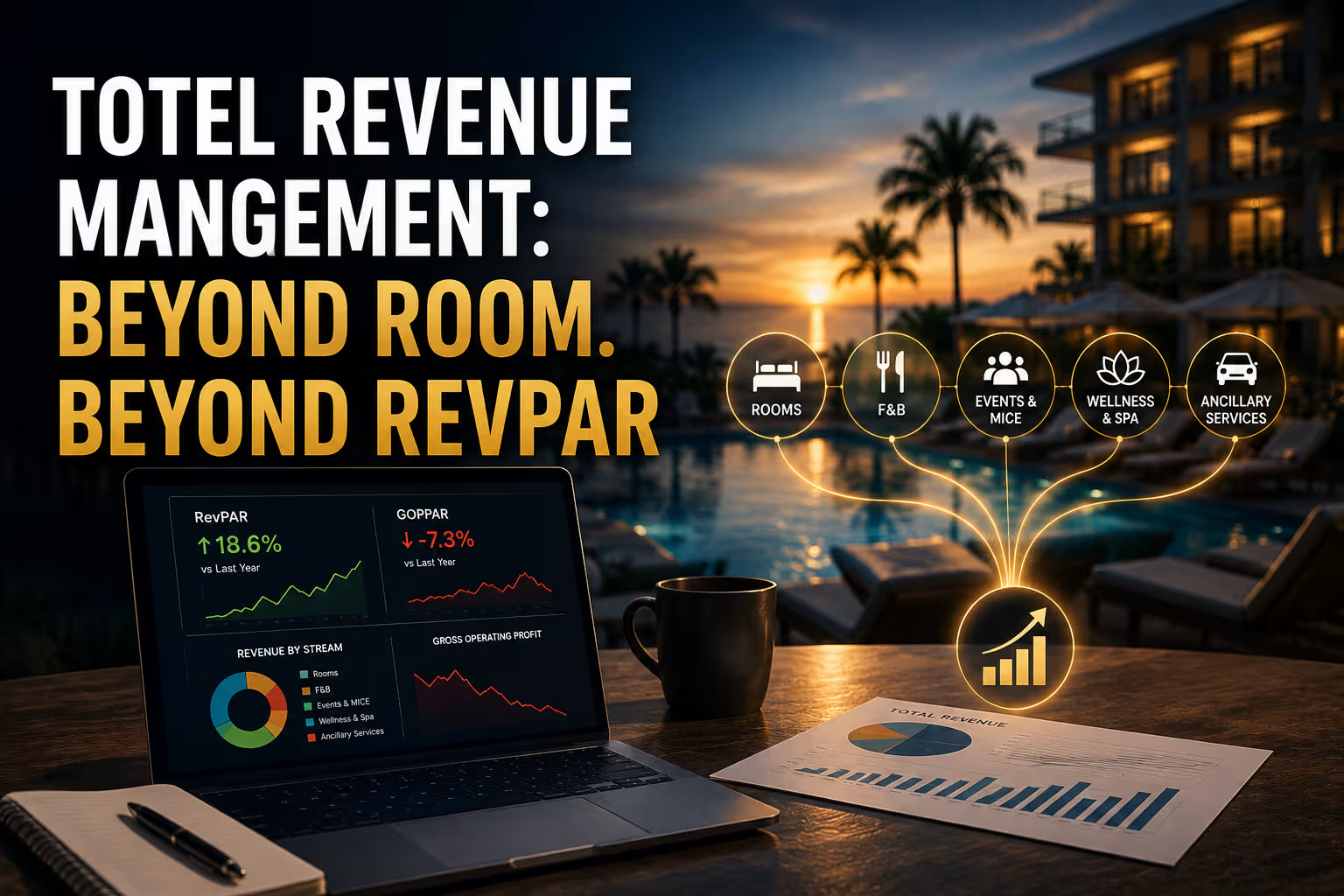
This matters because pushing for 100 percent occupancy often requires steep discounting, which drives up variable costs like housekeeping, laundry, and OTA commissions. Advanced systems shift the target from top-line RevPAR to GOPPAR (Gross Operating Profit Per Available Room). If an algorithm determines that selling the final 8 percent of inventory will yield a negative net operating margin due to acquisition costs, it will deliberately stop sales at 92 percent occupancy.
Properties transitioning to automated revenue forecasting consistently report a RevPAR uplift of 5 percent to 20 percent in the first year, with independent properties routinely capturing 10 percent to 15 percent gains. Human operators manually overriding these systems to flatten out rates out of fear are effectively neutralizing the exact uplift the software was purchased to capture.
A Framework for Commercial Control
To stop the silent revenue leaks and remove emotional panic from pricing decisions, commercial teams must change their operational processes immediately.
-
Enforce strict Displacement Analysis. Never accept base-loading group business at a discount during historical high-compression windows without running a probabilistic calculation of displaced transient revenue. If the bid price of the final room sold exceeds the marginal revenue of the group room, the contract must be rejected.
-
Deploy Automated MLOS Restrictions. For the Indian market, mandate an automated 2-night or 3-night minimum length of stay restriction across all distribution channels 45 to 60 days prior to any public holiday weekend to prevent orphan nights.
-
Protect the Public Rate Floor. Remove human emotion from the 14-day booking window. Establish a firm policy against visible last-minute discounting on public channels. Shift all distressed inventory to opaque distribution channels, loyalty upgrades, or localized Closed User Groups (using WhatsApp payment links) to bypass OTA commissions and protect brand equity.
-
Target Profit, Not Occupancy. Transition commercial key performance indicators from targeting 100 percent occupancy to optimizing for GOPPAR. Implement pricing engines that automatically restrict lower-rated channels when the marginal cost of servicing the room exceeds the net revenue of the discounted rate.
The Contrarian Conclusion
The sheer velocity of modern digital booking channels exceeds human processing capacity. Attempting to manage dynamic pricing manually in a spreadsheet is like day-trading on a high-frequency stock exchange using a printed newspaper.
Operators clinging to manual approval workflows are throttling the very technology designed to protect their assets. The most critical decision a hotel owner or general manager can make is recognizing that standardizing a broken manual process does not make it safer. It simply guarantees that the business will lose money systematically, efficiently, and silently.
Ready to build an automated revenue forecasting strategy tailored to your property?
Grow Engine works with independent properties across India and globally to implement revenue management and OTA optimization systems that fit your market, your guests, and your goals.
Explore our Hotel Revenue Management and Hotel OTA Management solutions, or Get in touch today through https://www.growengine.in/contact.