

Key Takeaway: Restricting competitor rate synchronization to exactly twice daily protects your pricing algorithm from destructive phantom demand noise while maximizing total asset profitability.
The 10:00 AM Rate Drop That Defines Reactive vs Strategic
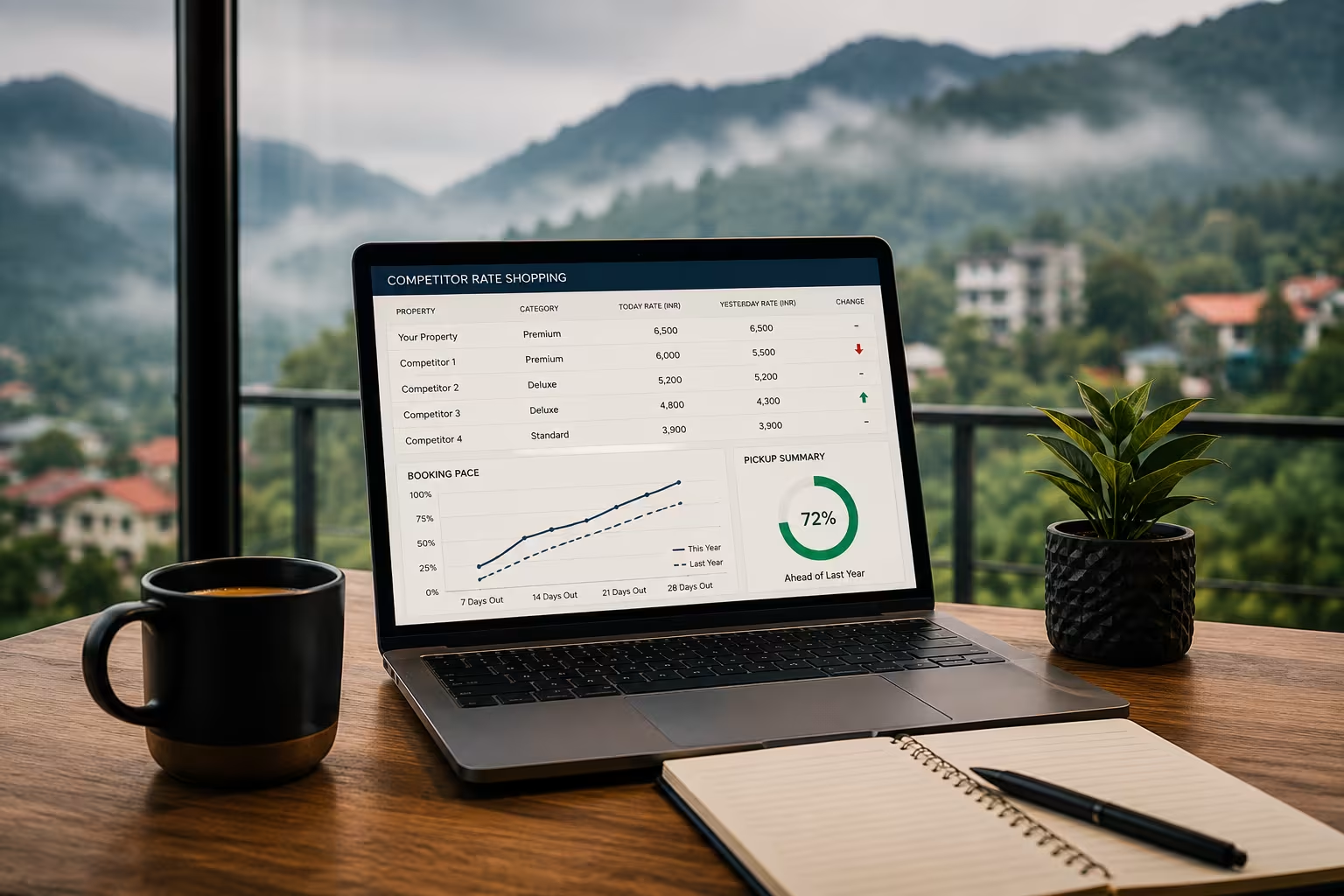
It is 10:00 AM on a rainy Tuesday in Munnar. A 45-room boutique resort's revenue manager stares at the operational dashboard on their screen. The primary competitor just dropped their weekend rate by 500 INR. This exact moment defines the difference between a reactive property and a strategic one. Proper hotel rate shopping dictates how a property should respond to this operational trigger.
The reactive revenue manager panics. They assume market demand is collapsing and instantly drop their own rate by 550 INR to maintain top placement on the online travel agencies. A few kilometers away, a strategic commercial director sees the exact same alert. Instead of matching the price, they check their internal booking pace, notice they are pacing ahead of last year, and leave their rate untouched. The first property triggered an automated price war that eroded their profit margin. The second property protected their asset value. How often should you actually look at your competitors to maximize yield without destroying your own strategy?
Where Conventional Hotel Rate Intelligence Fails
The conventional approach to competitive intelligence relies on a flawed foundational assumption. The hospitality industry generally believes that if a property knows exactly what its competitors are charging in real time, it can perfectly position its own pricing to maximize yield. This belief creates a culture of obsessive monitoring.
The Practical Insight: High-frequency competitor rate matching actively damages your transient forecasting accuracy.
Why It Happens: When you constantly tinker with your prices to match competitors, you introduce "phantom demand noise" into your own algorithms. The system never learns the true price elasticity of your guests because you refuse to let the market react to your established price point. Furthermore, engaging in constant price matching creates Bertrand competition. Perfect information asymmetry simply drives market prices down to the marginal cost of production. When commercial leaders override algorithmic forecasts multiple times a day, sometimes reaching up to 28 manual overrides, they initiate an algorithmic price war. Competing systems continuously underbid each other based on entirely artificial data.
Real-World Example: A competitor receives a sudden group cancellation of ten rooms. They drop their rate to liquidate that specific distressed inventory quickly. If your automated rate shopper matches that drop instantly, a third competitor sees the compression and drops their rate as well. Suddenly, the entire local market is heavily discounted. However, no new travelers were created by these discounts. You just sold your rooms to the exact same guests for significantly less money.
The Action to Implement: Configure your revenue management systems and third-party intelligence tools to pull competitor data a maximum of twice per day to starve the algorithm of reactionary noise.
The Algorithmic Rate-Shielding Framework for Hotel Rate Shopping
To break the cycle of obsessive monitoring and reactionary pricing, properties must transition from passive rate observation to active demand management. You can achieve this by implementing a predictive framework known as Algorithmic Rate-Shielding. Validation via large-scale Monte Carlo simulations of resort inventory demonstrates that this framework achieves a 14.2 percent Gross Operating Profit Per Available Room protection baseline simply by programmatically suppressing reactionary downward rate adjustments that lack structural demand validation.
The Practical Insight: You can programmatically suppress reactionary downward rate adjustments that lack structural demand validation by adding a specific workflow filter.
Why It Happens: Adding a validation layer between external competitor pricing feeds and your internal Property Management System forces your team to evaluate actual business conditions. It shifts the focus from competitor behavior to internal pickup velocity.
Real-World Example: A revenue manager sees a competitor drop rates but notices their own direct website search velocity remains high. They hold the rate and still sell out the property.
The Action to Implement: Implement the following internal validation protocols before authorizing any defensive price reduction.
Enforce Strict Frequency Constraints
The Problem: Commercial leaders override algorithmic forecasts with alarming frequency, severely degrading the accuracy of transient forecasting as the arrival date approaches.
Why It Works: Limiting synchronizations to specific intervals, such as 8:00 AM and 3:00 PM, provides sufficient data to track macroeconomic trends. It simultaneously starves the system of the micro-fluctuations that cause phantom noise.
Real-World Intuition: You do not check the stock market every five minutes if you are investing for a ten-year retirement horizon. You should not check your compset every hour when selling rooms for a weekend arrival that is still three weeks away.
Implementation Advice: Lock the refresh settings in your rate shopper and strictly prohibit manual grid checks by your front office team during the workday. Time saved from obsessive monitoring must be redirected toward analyzing internal pickup and booking pace.
Require Internal Pickup Validation
The Problem: Properties react to competitor rate drops even when their own booking pace is perfectly healthy.
Why It Works: Validating external noise against internal data ensures you only react to actual market shifts. If guests are not canceling their existing bookings at your property to rebook with the cheaper competitor, the market is not highly price-sensitive at that moment.
Real-World Intuition: A nearby restaurant offering a discount does not mean you must discount your steaks if your dining room is already fully booked for the evening.
Implementation Advice: Before matching a competitor price drop, verify that your internal booking pace for that specific target date is actually lagging significantly behind historical benchmarks. If internal pickup is strong, hold your rate.
Deploy Opaque Value Bundling
The Problem: Transparent base rates allow competitors to easily scrape and undercut your pricing in real time.
Why It Works: Decision science research regarding the one-click effect demonstrates that consumers have significantly lower price sensitivity when buying bundled packages. Bundling obscures your base rate from automated scrapers, making direct price comparisons mathematically impossible for the consumer.
Real-World Intuition: A guest comparing two 5,000 INR rooms will quickly choose the cheaper one if you drop it to 4,800. But comparing a 4,800 INR naked room to a 6,500 INR package including airport transfers, a dining credit, and a spa consultation makes a direct line-by-line comparison impossible.
Implementation Advice: Build and distribute at least one comprehensive experiential package that bundles high-margin ancillaries with your standard room rate to bypass direct Bertrand competition.
A Monday-to-Friday Revenue Strategy in Munnar
The necessity of this disciplined framework becomes acutely apparent when analyzing the commercial realities of independent properties in drive-to leisure destinations across South India. Places like Munnar, Coorg, and the Western Ghats represent unique micro-economies that defy traditional urban revenue management logic.
The Practical Insight: Daily revenue management in a drive-to leisure market requires prioritizing direct channel optimization over average rate index obsession.
Why It Happens: Independent resorts face compressed booking windows and highly volatile, weather-dependent demand. They do not compete on standard corporate transit metrics. If they blindly follow urban revenue models and match heavily discounted wholesale blocks from neighboring properties, they will artificially suppress rates right before weekend compression hits.
Real-World Example: Consider a realistic week for an independent property in Munnar executing Algorithmic Rate-Shielding.
On Monday morning, the 8:00 AM rate shop reveals slow market pickup for the upcoming weekend.
On Tuesday, the primary competitor panics and drops their rates across all online travel agencies.
On Wednesday, the Munnar property's revenue manager holds firm because direct website search velocity remains remarkably strong.
On Thursday, a spontaneous long weekend is announced locally, and regional demand spikes drastically.
By Friday afternoon, the Munnar property sells out at a premium rate. Their competitors are already full at heavily discounted prices, having dumped their inventory too early. By utilizing advanced market intelligence strictly to inform strategic positioning rather than reactive price matching, the property achieved an 18 to 26 percent average rate increase over the market.
The Action to Implement: Track your direct channel profitability daily instead of fixating solely on your Market Penetration Index.
The Psychology Behind Irrational Competitor Compset Analysis
If the mathematics prove that obsessive competitor compset analysis degrades forecasting accuracy and triggers margin-destroying price wars, why do highly educated commercial leaders continue to do it? The answer lies outside of hospitality analytics and squarely within the realm of behavioral economics. Hospitality operators function in an environment characterized by extreme perishability. A room night cannot be stored on a shelf and sold tomorrow. This reality creates a psychological pressure cooker.
The Practical Insight: Human decision-makers consistently prioritize the avoidance of an empty room over the statistical probability of a higher-priced booking.
Why It Happens: Prospect theory and loss aversion dictate that the psychological pain of losing a potential booking is far more intense than the satisfaction of maximizing yield. Additionally, anchoring bias causes managers to fixate on the absolute visible price of the nearest competitor. They completely ignore their own superior product offerings. Dual processing theory posits that human judgments result from two competing systems of thought. In the high-stress environment of daily revenue management, the fast, emotional, and intuitive system frequently overrides the slow, deliberative, and logical system.
Real-World Example: A commercial leader opens their dashboard at 9:00 AM and sees a lesser competitor priced at 4,000 INR. This number instantly becomes the emotional anchor. Despite having vastly superior guest review scores and a fundamentally different cost structure, the manager feels intense anxiety. They cap their own rate at 4,500 INR, needlessly sacrificing yield just to feel a sense of control over the unpredictable market.
The Action to Implement: Mandate that any manual price reduction below the algorithm's recommendation must include a written justification citing internal pacing failures, explicitly removing emotional anchoring from the pricing workflow.
What Independent Properties Should Do This Week Regarding Rate Shopping
Shifting away from an obsession with external rate parity requires discipline. Independent properties lack the massive distribution networks of global brands. When they engage in direct rate wars on third-party platforms, they are playing a rigged game. The algorithms prioritize properties that offer the highest conversion probability and the largest commission margins. Engaging in a race to the bottom simply surrenders the property's profit margin to third-party acquisition costs.
The Practical Insight: Shifting your operational habits immediately reclaims lost profit margins and forces the commercial team to trust the mathematics of their demand forecast.
Why It Happens: Taking swift, localized actions removes the emotional burden from pricing decisions. It insulates your rates from external visibility and competitive scraping. Verified data demonstrates that optimized direct bookings yield 3 to 5 times higher profitability than third-party reservations.
Real-World Example: An independent hotel stops checking OTA grids hourly, bundles their breakfast and spa services into an opaque rate, and immediately experiences higher direct booking conversion rates because competitors cannot scrape and undercut their exact offering.
The Action to Implement: Execute these exactly five steps before your next revenue meeting.
| Step | Action | Details |
|---|---|---|
| 1 | Configure intelligence tool sync schedule | Synchronize competitive data exclusively at 8:00 AM and 3:00 PM daily |
| 2 | Audit your competitive set | Base selection on actual guest substitution behavior, not geographical proximity |
| 3 | Exclude erratic competitors | Remove competitors with desperate, erratic pricing behavior from your primary algorithm feed to prevent data distortion |
| 4 | Launch an opaque experiential package | Bundle high-margin ancillaries with your standard room rate on your direct website to shield your base rate from automated scrapers |
| 5 | Shift your primary performance metric | Track Direct Booking Revenue per Available Room instead of Average Rate Index |
Conclusion
The evolution of hotel revenue management has provided commercial leaders with unprecedented access to competitive data. However, access to data is not synonymous with an obligation to react to it. The industry's current fixation on high-frequency checking is a byproduct of behavioral anxiety, not mathematical optimization.
The true measure of a successful revenue strategy is not whether a property matched a competitor's lowest rate on a Tuesday afternoon. The true measure is whether the property maximized the fundamental profitability of every available room. The data unequivocally proves that optimized direct bookings generate 3 to 5 times higher profitability than equivalent reservations acquired through third-party platforms. When a property captures the entire profit margin without surrendering massive percentages to commissions, it can afford to lose the lowest-tier, hyper-price-sensitive guests to its competitors. Stop managing your competitors and start managing your own demand.
Review your system settings today and restrict rate syncing to twice daily. Draft a policy requiring internal pace validation before any defensive price drops are authorized.
Ready to build a pricing strategy tailored to your property? Grow Engine works with independent properties across India and globally to implement revenue management systems that fit your market, your guests, and your goals. Get in touch today.