

Key Takeaway: OTA commissions of 15–25% per booking are the single largest controllable cost for most independent hotels in India. Reducing that dependency is not a marketing project — it is a revenue management decision.
The OTA Commission Problem in Indian Hospitality
If you run an independent hotel in India, a significant portion of your revenue is almost certainly flowing through Booking.com, MakeMyTrip, Agoda, or Goibibo. That is not unusual. These platforms have made it easier than ever for guests to discover and book properties. The problem is not the platforms themselves. The problem is the cost.
OTA commission rates in India typically sit between 15% and 25% of the booking value. On a room priced at Rs 5,000 per night, that is Rs 750 to Rs 1,250 gone before you have served a single breakfast. Multiply that across 200 nights of occupancy in a year on a 20-room property and the number becomes very large very quickly.
The deeper issue is that most independent hotels have no plan to change this. They rely on OTAs by default, not by design. That is the problem this article addresses directly.
Why Independent Hotels Become OTA-Dependent in the First Place
OTA dependency is rarely a conscious choice. It is the path of least resistance. When a hotel opens, the OTAs offer immediate visibility and bookings with no upfront marketing cost. That is genuinely valuable. The channel manager gets connected, the listings go live, and bookings start arriving. The commission feels like a reasonable cost of doing business.
The problem develops gradually. The hotel grows comfortable with the booking volume, never builds its own direct booking infrastructure, and the OTA share quietly becomes 70%, 80%, or more of all bookings. By that point, the commission is baked into the cost structure and the hotel has lost the ability to negotiate from a position of strength.
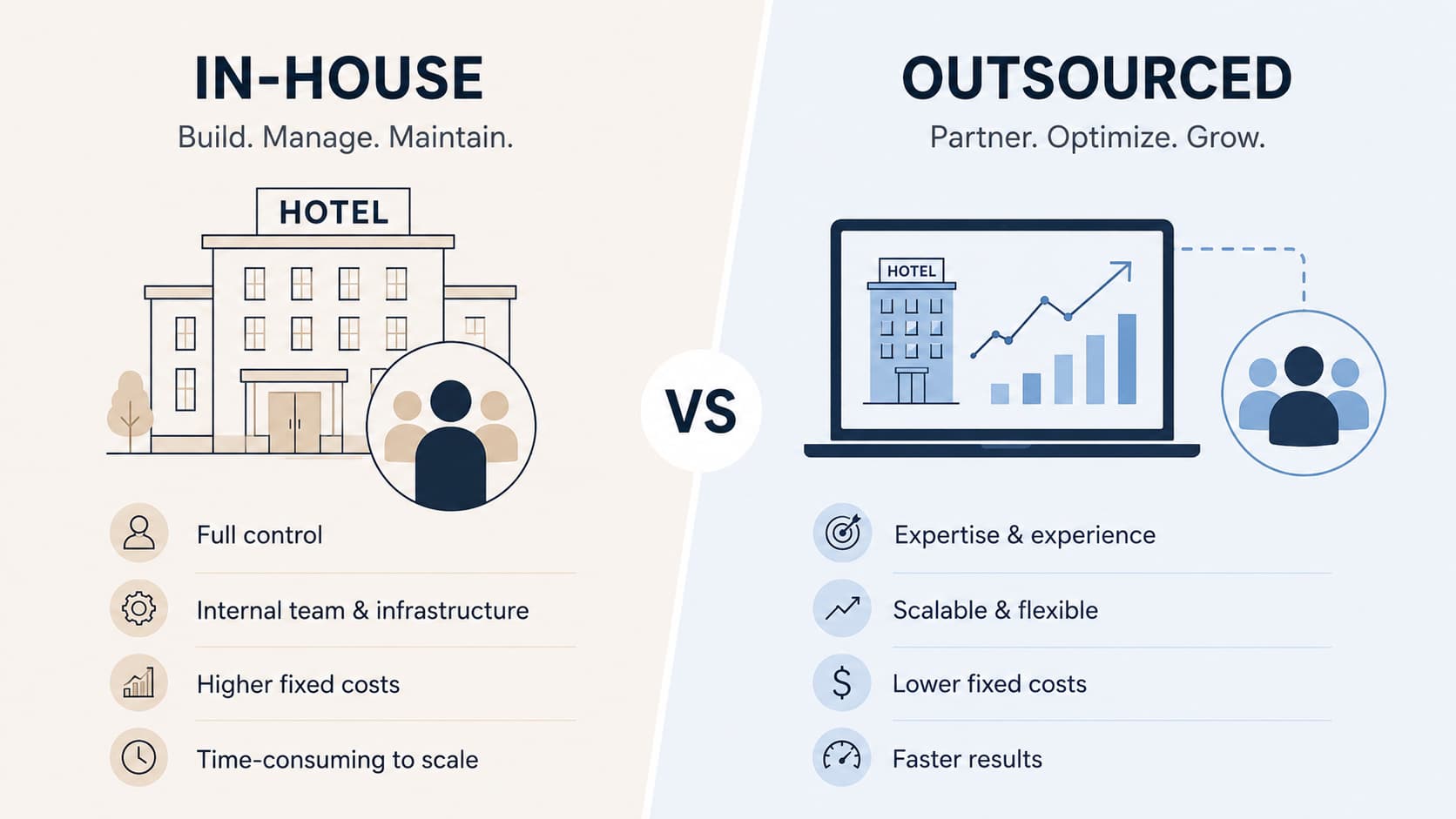
Independent hotels also frequently lack the internal expertise to run their own direct booking campaigns. Revenue management requires consistent attention, market knowledge, and tools that many small properties do not have in-house. OTAs fill that gap — at a steep ongoing cost.
The Real Cost of OTA Dependency
The 15–25% commission range understates the true cost for two reasons.
First, OTA bookings typically arrive at discounted rates. Many hotels offer their lowest prices on OTAs to compete for algorithm ranking, which means the commission is calculated on a rate that is already lower than what a direct guest might pay. The actual revenue retained per OTA booking is often significantly lower than the headline room rate would suggest.
Second, direct bookings are 3–5x more profitable than OTA bookings when you account for commission savings, higher ADR, and the absence of intermediary friction. That is not a marketing claim. It is the conclusion of research published by Skift Research analyzing booking channel profitability across independent hospitality properties.
The difference between a property running 70% OTA bookings and one running 40% OTA bookings — at the same occupancy and headline rate — can be tens of lakhs in annual net revenue.
Five Strategies to Reduce OTA Dependency
| Strategy | Key Action | Primary Benefit |
|---|---|---|
| Build a direct booking website | Fast, mobile-ready site with booking mechanism | Commission-free bookings, Google visibility |
| Use a channel manager | Centralised rate and inventory control across OTAs | Reduced commission, no parity violations |
| Grow repeat guest relationships | WhatsApp/email outreach to past guests | Zero acquisition cost, highest conversion rate |
| Improve Google presence | Google Business Profile + SEO-optimised website | Guests find you before OTAs |
| Offer exclusive direct incentives | Late checkout, amenity, room preference | OTA cannot match experience-based perks |
1. Build a Direct Booking Website
This is the foundation. A property without its own website has no credible alternative to OTA bookings. Guests who search your property name find nothing, or find only your OTA listings — which means the OTA captures the booking and the commission.
A well-built hotel website does not need to be complex. It needs to be fast, mobile-ready, clearly written, and equipped with a working inquiry or booking mechanism — a contact form, a WhatsApp link, or a direct reservation email. Guests who find your website and can contact you directly represent commission-free bookings.
More importantly, a website gives you a presence on Google that OTAs cannot fully own. A guest who searches your property name by name, after seeing it on a recommendation or social media, will find your website first if it is properly built and optimised.
2. Use a Channel Manager to Maintain Rate Parity While Shifting the Booking Mix
Rate parity is often misunderstood as a reason to avoid offering direct booking incentives. In practice, it means your publicly listed rates across all OTAs should match. It does not prevent you from offering added value — a complimentary early check-in, a welcome amenity, or a room upgrade — exclusively to direct bookings.
A channel manager lets you manage your OTA inventory from a single place while protecting your rate integrity. As you grow your direct booking capability, you can gradually reduce the inventory allocated to higher-commission channels and shift availability toward your direct channel without creating the rate parity violations that trigger OTA penalties.
3. Grow Repeat Guest Relationships Through WhatsApp and Email
The most efficient direct booking source is a guest who has already stayed with you. They know the property, they trust it, and they do not need an OTA to make the decision for them. The problem is that most independent hotels collect guest contact details and then do nothing with them.
A simple WhatsApp broadcast or email at the right moment — before a peak season, during a promotional period, or at the anniversary of their last stay — can generate direct bookings at zero commission. The guests are warm. The relationship exists. The cost of acquisition is essentially zero.
This does not require sophisticated CRM software. A curated WhatsApp group or a simple email list maintained in a spreadsheet is enough to start.
4. Improve Your Google Presence So Guests Find You Before They Find Booking.com
Google is where most booking journeys begin. A guest who is considering a trip to Coorg or Wayanad will search generic terms before they search by property name. If your property does not appear in those searches — or appears far below the OTA listings — you are invisible at the moment of highest intent.
Improving your Google presence means three things: a Google Business profile that is complete, accurate, and actively managed; a website with the right content and technical structure to rank for your location and property type; and consistent, high-quality reviews that signal trust to both the algorithm and the guest.
None of this replaces OTAs overnight. But over 6–12 months, a property with a strong Google presence will see its direct booking share grow as guests find it before they reach the OTA discovery layer.
5. Offer Exclusive Direct Booking Incentives That OTAs Cannot Match
OTAs compete on price and convenience. You can compete on experience and personalisation in ways that no OTA can replicate. A guaranteed late checkout, a complimentary airport transfer, a room preference stored from a previous stay, or a personal message from the host — these are direct booking advantages that an OTA listing cannot offer.
Communicating these incentives clearly on your website and in any direct marketing you do turns your property's personality into a booking differentiator. Guests who value the direct relationship will choose it, especially at the same or similar price.
How to Measure Your Progress
The single most useful metric for tracking OTA dependency reduction is your direct booking percentage: the share of total room nights booked through your own direct channels rather than through OTAs.
Most independent hotels do not track this number. They track total bookings or revenue, but not the channel split. Start tracking it monthly. Even a five-percentage-point shift in your direct booking share — from 20% to 25% of room nights — represents a meaningful reduction in commission costs at scale.
Set a 12-month target. A realistic goal for most independent properties starting from a high OTA dependency baseline is to increase direct share by 10–15 percentage points over the first year of focused effort. That is achievable without aggressive discounting or major marketing spend, if the foundations — a website, a direct inquiry mechanism, and a guest relationship approach — are in place.
Reducing OTA Dependency Is a Long-Term Revenue Decision
There is no shortcut. Reducing OTA commission dependency takes time, consistency, and the right infrastructure in place. But the return on that effort compounds over time. Every percentage point of direct booking share you gain is a recurring improvement in your net revenue per room.
If you want to understand where your current revenue is going and what a realistic path to lower OTA dependency looks like for your property specifically, we offer a free revenue audit at Grow Engine. No commitment. We look at your current channel mix and identify the changes that would have the largest impact on your bottom line.
The commission you pay today does not have to be the commission you pay next year. The shift starts with a decision to treat direct booking growth as a revenue management priority — and then building the systems to make it happen.
Learn more about our OTA Management services or explore our Revenue Growth approach to see how we put this into practice for independent hotels across India.